

In 2025, Zikoko, the youth-friendly digital publication well-known for its lifestyle articles and pop culture quizzes, moved into film production, commissioning three short films from young Nigerian filmmakers to bring some of their popular stories to life. Among them was Dika Ofoma who wrote and directed the age gap romance Something Sweet, and who returns to the franchise this year with something new and bittersweet.
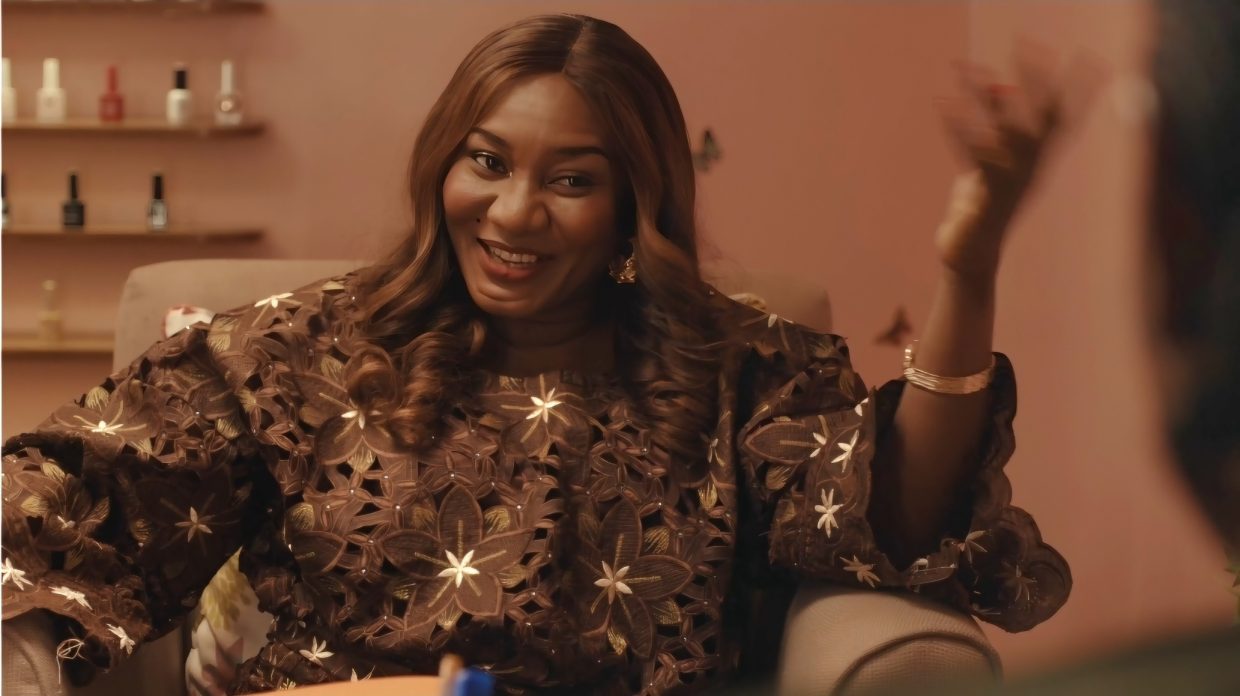
In A Happy Ending, Ofoma’s sophomore output for the Zikoko Life series, we are introduced to Tatiana (Ifeoma Obinwa), a masseuse newly relocated from Awka to Lagos in search of a better-paying job that will help her save for university. Her friend Ginika (Ruby Okezie) introduces her to Madam Ngozi (Anne Njemanze), a spa owner who employs her and encourages her to capitalize on her sexuality when one of her clients, a serving senator (Nonso Odogwu), requests an unorthodox addition to his regular massage.
 A small town or village belle moving to the big city where she falls into sex work after being led astray by people she trusts is a well-worn Nollywood trope. Taken at surface value, A Happy Ending can be viewed as a hankering for the narrative aesthetics of Nollywood’s golden era. The simple and somewhat predictable plot line, the hand-painted film poster by Tife Sonaike, the presence of Njemanze who famously played the titular sex worker role in Zeb Ejiro’s 1996 drama Domitilla, and the fact that Ofoma proudly wears his love for classic Nollywood on his sleeve all encourage this assumption, however Ofoma’s offerings to the viewers of this film cannot be limited to mere nostalgia.
Look past the entertainment factor and you will see that what the auteur has presented here is a 35-minute seminar on gender and labour. There is a lot to unpack in how, as women who work in the hospitality and service industry, Tatiana and Ginika, a waitress, often have their primary work conflated with sex work, and the pressure that puts them under.
Power dynamics come to the fore in the scene where Madam Ngozi advises Tatiana on safe sex and counsels her to assert her autonomy in her dealings with the senator. Their exchange comes off as ‘women supporting women’ until you remember that it was the older woman who originally manipulated Tatiana into the vulnerable situation she now finds herself trapped in.
 A Happy Ending also challenges the oversimplification of sexual assault as something that occurs only when brute force is applied. Sometimes, as the film does well to show, sexual assault takes the shape of stealthing — non-consensual tampering or removal of a condom mid-coitus, and at other times, it is inflicted on the victim through coercion.
The film also makes a subtle observation on the Nigerian approach to morality and ethics – how quickly no’s and never’s lose their stridency and become okay’s as soon as the words ‘God’, ‘grace’, and ‘favour’ are used to justify questionable decisions.
With its bilingual dialogue, A Happy Ending also continues Ofoma’s commitment to representing the Igbo language on screen as he did in earlier shorts like God’s Wife, A Japa Tale, and A Quiet Monday. Efforts like Ofoma’s not only help stave off the disappearance of what is often touted as an endangered language, but extend the argument that indigenous-language media does not have to be synonymous with unintelligent scripting or uneven production values.
Ofoma favours naturalistic enactments. Where other directors might demand theatrically exaggerated performances, he encourages his actors to fine-tune the microscopic aspects of their facial expressions and body language instead.
His predilection for nuance is also admirable evinced by how he makes Tatiana and Ginika worldly but still vulnerable, and how he resists the temptation to frame their quest for financial independence as a desire borne out of profound desperation. Unfortunately, his over reliance on dialogue over wordless interactions for exposition suggests a distrust of the audience’s capability for discernment.
The film’s hopeful conclusion will likely trigger conversations about what actually constitutes a happy ending and as to be expected, opinions will likely vary, but if anyone wants mine, I would say that the happiest of endings is one which testifies to its protagonists’ resilience and celebrates their autonomy.
 A Happy Ending is streaming on Youtube.
Akumbu Uche is a writer and storyteller from Nigeria. A regular contributor to thelagosreview.ng, her work in arts journalism and cultural criticism has also been published by Cultbytes, IMPULSE Magazine, The Nation, New African Magazine, Service95 and Strange Horizons. Follow her on X.