

Most Nigerian romantic comedies have been organised around a particular language of desire: the woman is chosen and does not choose.
She is the object of the man’s pursuit, the reward at the end of his effort, the one whose feelings materialise primarily in response to what is done to her rather than what she initiates herself. This is not merely a storytelling convention. It is a cultural instruction, dressed in the language of tradition and femininity, about how a Nigerian woman’s romantic identity should be held until a man decides to acknowledge it.

Call of My Life, written by Uzoamaka Power and directed by Dammy Twitch, is a film that knows this language and has decided, with considerable charm and only occasional uncertainty, to go against it.
Power plays Soluchi, a call centre agent whose emotional texture runs at a frequency the city around her has not been calibrated to receive. She’s quirky and high spirited. She spins on the pavement on her way to work. She gives herself completely to whatever she sets her heart on, which in the film’s opening act is Kalu (Zubby Michael), a financially comfortable Igbo businessman whose love language is his debit card. Their incompatibility is not framed as a class problem or a morality problem. It is framed, with surprising precision, as a language problem: two people who cannot hear each other because they are not speaking the same emotional dialect. When Kalu ends things, he tells Soluchi she loves too much, cares too much, is too available.
Into this heartbreak arrives Eli (Andrew Bunting), a Ghanaian newscaster who reaches Soluchi through a customer service call and finds, in her voice, something worth pursuing. Their courtship is built on conversation, and it is here that the film makes its central argument most clearly: that love as emotional availability, as genuine curiosity about your partner’s interior life, is not naivety or excess. It is the standard. What Soluchi has been made to feel ashamed of is, the film insists, precisely what she should be looking for.
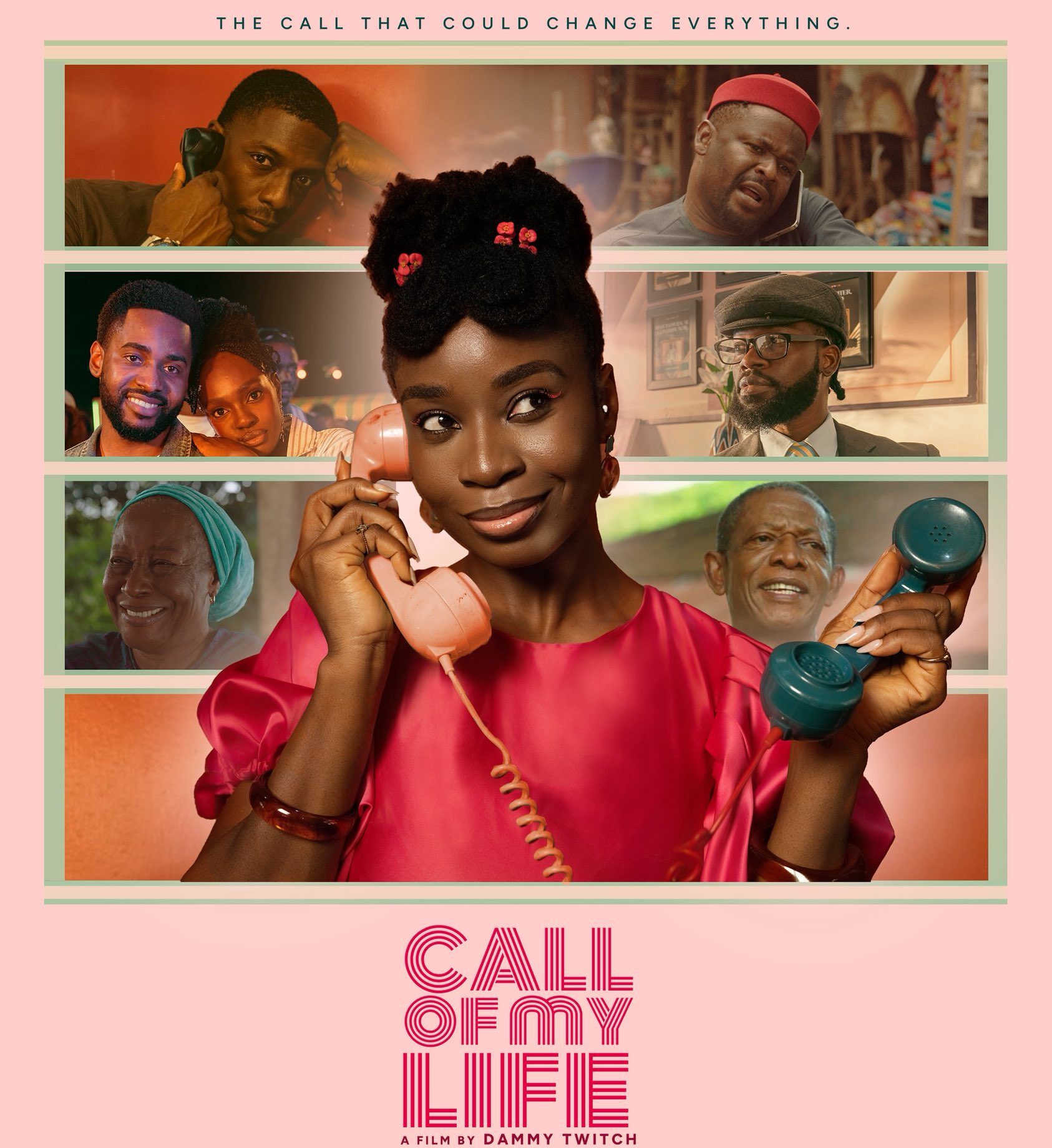
Power’s performance carries the film’s emotional argument on its back without straining under the weight. She plays Soluchi with an expressive precision that never tips into over performance; the character’s quirks feel inhabited rather than constructed, her vulnerability genuine rather than deployed.
Bunting is warm and capable, and his chemistry with Power is the film’s most reliable pleasure, though the screenplay’s decision to introduce him relatively late and develop him primarily in relation to Soluchi means that Eli exists more as emotional reward than as a fully imagined person. We learn about Soluchi’s parents’ romantic history before we learn what Eli does on an ordinary Tuesday. For a film so interested in being truly known, this is an irony worth noting.
Twitch’s direction, for one pivoting from short form music videos to a long form feature, deserves more credit than the film’s screenplay-centred critical conversation has afforded it. His visual instinct is for emotional atmosphere rather than ostentatious display: locations are chosen for feeling rather than status, lighting is soft without being saccharine, and the editing, particularly in the film’s airport sequence, holds the camera faithfully in the characters’ emotional perspective rather than reaching for conventional climactic spectacle. The production design, costuming, and Cobhams Asuquo’s score collectively build a world that feels aspirational without feeling dishonest.
The screenplay, which is Power’s debut feature-length script, shows both the confidence of a writer with a clear vision and the unevenness of one still developing structural discipline. Consequential moments occasionally happen offscreen. The conflict in its middle section stretches beyond its tension. Eli remains frustratingly underwritten. And certain narrative transitions ask the audience to accept emotional conclusions the story has not fully constructed. These are real limitations, and they prevent the film from achieving the seamlessness its best scenes suggest it is capable of.
But Call of My Life understands something that matters: that romantic comedy is not an inferior form requiring apology, but a precise one requiring craft. It knows its audience, honours their emotional intelligence, and builds a heroine who does not shrink to be loved.
Call of My Life may not be perfect, but for the hopeless romantics and indeed the wider Nollywood audience, it is a step in the right direction and has set the bar for contemporary rom coms going forward.
**Joseph Jonathan is a Film & Culture Critic. Catch him on X @chukwu2big