

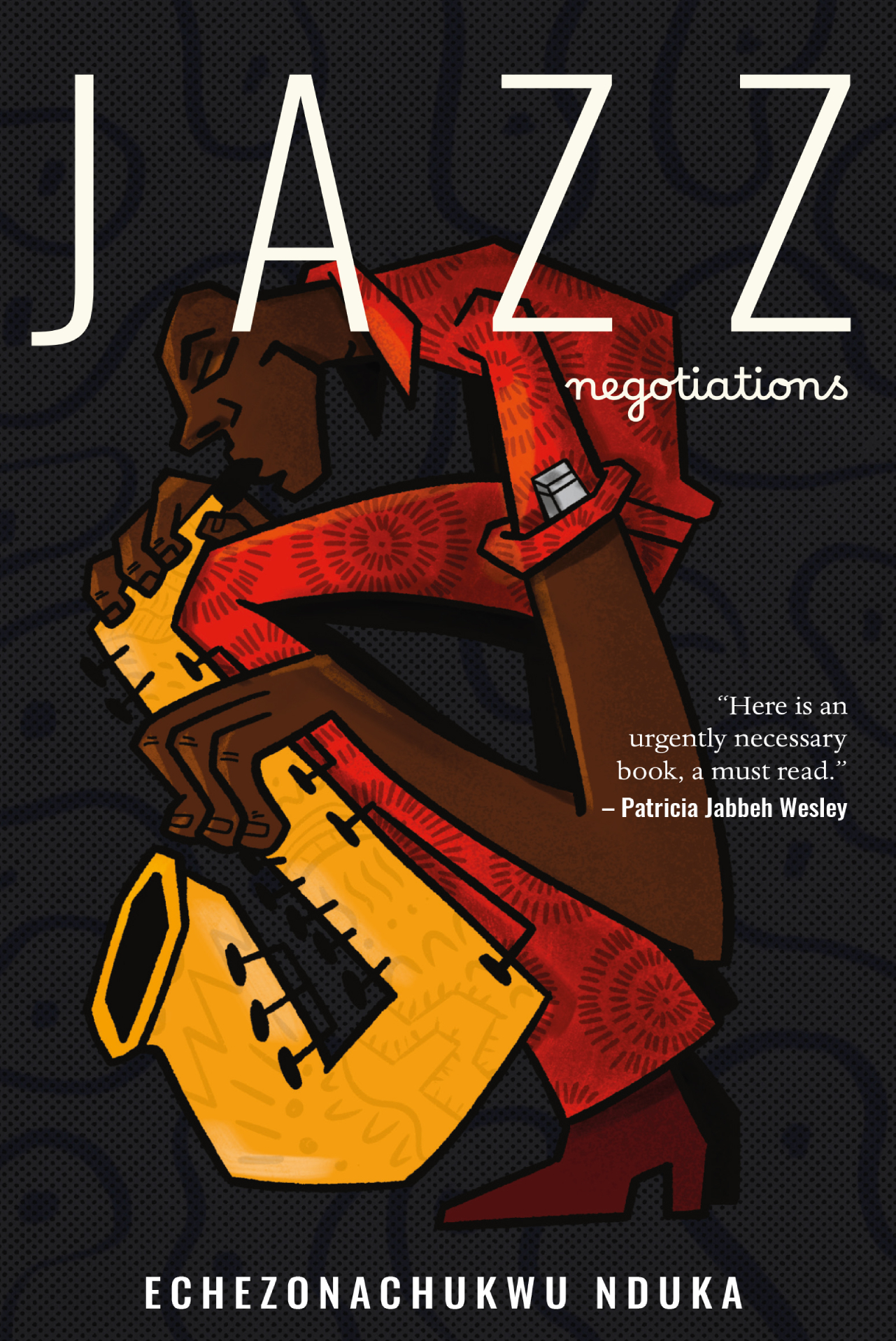
Jazz Negotiations, Echezonachukwu Nduka, Masobe Books, 2026, 112 pages
“What is life without jazz, without rhythm and harmonies tearing down walls?”
—Echezonachukwu Nduka, Jazz on the Highway
Jazz, as an art form, has long thrived on the tension between structure and freedom, improvisation and predictability and in a world where the genre is often pronounced dead or diminished, Echezonachukwu Nduka’s Jazz Negotiations insists otherwise.
In that vein, this poetry collection can be taken as a musical performance that bears Nduka’s own act of spontaneous interaction with music, history, life, and the audience.
That performance opens with a prologue of sorts. With “Arrival”, Nduka invites the reader into a particular kind of devotion. When he writes, “I testify that dreams made of music are better than life without sound,” it comes with the conviction of a worshiper before an altar.
The architecture of Jazz Negotiations is in itself a mark of deliberate craftsmanship. After “Arrival,” the sixty poems that follow are organized into four parts that mirror the classic AABA jazz standard, being the form in which a theme is stated, restated, departed from in a contrasting bridge, and finally returned to for resolution.
 The first section, A1: SOUNDING THE STRINGS, establishes the theme: the supremacy of sound itself. In “Jazz Abibiman,” Nduka declares that “sound is a sanctuary,” and is “deep enough to contain joys,” exalting music’s potency across guitar solos, saxophone riffs, and vocal ululations. When he imagines a song turning one into “a dictator’s archenemy,” due to an army losing “battle to a fusion of jazz and funk,” it’s hard not to think of Fela Kuti defying military regimes with what would become Afrobeat. Music, in this section, is revealed as a force capable of sustaining or igniting revolution.
Music, indeed, functions as religion throughout Jazz Negotiations. When Nduka confesses in “Ubo-aka”, that: “I am an acolyte at the shrine of sound,” he implies that no one may approach this faith with arrogance. It is why, in “Ghosting,” the poet can proclaim: “I have brought myself as an offering to fill the gap between silence and the next symphony.”
The intensity of A1 mellows into A2: REDREAMING THE TUNES, a variation reinforcing Nduka’s earlier convictions with religious overtones. The section also advances its own peculiar logic, that if the world ends it will do so in silence, and as such, life must therefore relish all sound while it can. In “Ecomusicology” and “Rhythmic Refusal,” humanity’s disconnection from nature becomes audible as “nature’s grief,” and Nduka stakes a clear ethical position: “I am saying no to the mass murder of trees.”
This section fades into B: IMPROVISO—CITIES, the point where the fixed theme breaks open and becomes a bridge, crossing over cities like Port Harcourt, Owerri, and Enugu. Amid the quotidian realities of these places, Nduka still searches for “a tune to break forth with glee for the wonders of living.”
A3: EXTENDED GROOVE & NEGOTIATIONS returns to theme, but transformed, as its title promises. Here the collection turns first to invocations examining racial tension in America, particularly where it erupts into police brutality and communal grief, as in “Neighbourhood Choir”: “How does one sing to life what the heart mourns for?”
For a diasporic writer of African descent, Nduka suggests, silence in the face of such daily dynamics is untenable. “A Seminar of Silence” insists that racism remains embedded in modern life, and that spirituals, hymns, blues, and jazz – the Black musical heritage, must be kept alive, never censored or erased from history.
And in “The Piano Is Burning,” perhaps the collection’s most searing poem, the poet carries the burden of bearing witness to the unbearable, insisting silence is not an option: “The piano is burning and all around me the smell of ascending smoke speaks for the dead in their numbers.”
From here, the section pivots tonally toward poems brimming with epiphany, such as “Interlude,” “Superstition,” “Hills,” “Online Status,” “This Is What I Want To Be Now”, all offering meditations on grief, love, loss, belief, identity, mental health and aging.
Ultimately, the poems of Jazz Negotiations celebrate music, sound, and the possibilities of language as they entwine intimately with every corner of existence. To read these poems is to appreciate the ingenuity of the collection’s structure, the depth and wisdom interlaced with melodic exhortation, the effortless movement from reverence to activism to observation to philosophy, so that one is ferried across borders: from protest to testimony, from recital to homage, from dirge to sensual rapture.
And even at the close of this performance, as the cultural and political negotiations fade and the audience disperses, we are reminded that every ending is only a fertile foundation for another story, a new beginning, a new song.
(Updated; Jazz Negotiations is not on the longlist for the Nigeria Prize for Literature. The error is regretted.)
Sima Essien is an award-winning writer based in Uyo, Nigeria.
Updated; Jazz Negotiations is not on the longlist for the Nigeria Prize for Literature. The error is regretted