

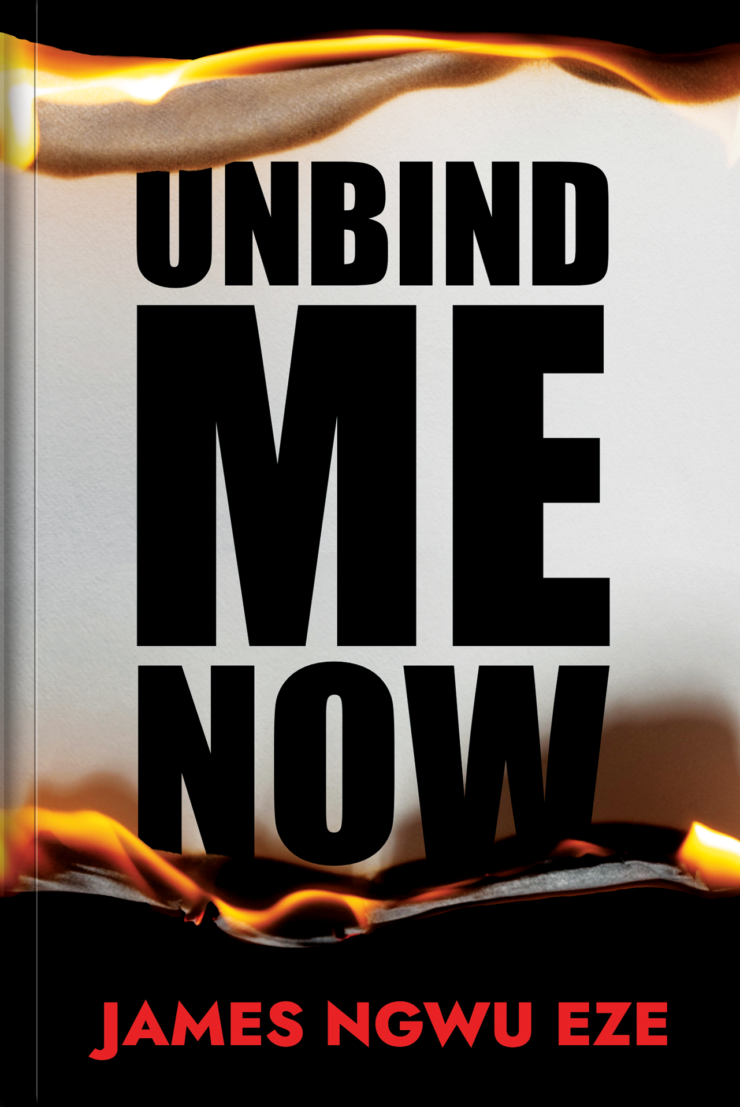
Unbind Me Now by James Ngwu Eze, Masobe Books 2026, 160 pages
A burning paper unfurls to reveal the words Unbind Me Now, boldened and capitalized, on the cover of the Nigerian poet, James Ngwu Eze’s, third collection of poetry. That fire burns on the cover, and throughout the seventy-one poems of the collection. Eze is fighting the fire that burns Nigeria with his ‘burning verses.’
Unbind Me Now continues from where his debut, dispossessed, stopped but this time around, Eze is a poet confident in his craft. Outraged and angered, he writes his manifesto, sculpts his poetry as if into fire, for “the poet sits in the tongue of the inferno, /a human shield against obstinate fate” – and with him his poetry.
This poetry belongs to the streets, wears thorns and is no lullaby. It tells the poet’s truth, hauls his rage, and refuses to be caged for “no chain can hold back a wronged soul.” It insists on memory, a “firefly lending light to history.”
Unbind Me Now is an intersectional cry for justice. It compiles the names of those felled by bullets. The military officers who died fighting terrorism, the unarmed protesters killed by the military and police, missing activists, citizens languishing in kidnappers’ dens. It wonders why men kill for gods, and enters the churches bearing the brunt of Boko Haram’s terrorism:
burnt bibles, broken altars
pews spattered with blood
shrieks of dying infants
and mothers forced into labour
Though heavily focused on Nigeria, it is as geo-spatial as it is intersectional. Across countries and continents, it decries political unrest, violence, xenophobia, and urges humanity to see in the COVID-19 pandemic our interconnection.
‘the hush we once lived in,’ the shortest section of the collection, is dedicated to this pandemic that emptied the streets in Lagos, New York City, and London, ‘a winter of worries’ that “made a fool of weapons”
In ‘to a grieving earth’ section, Eze goes eco-critical. He uses this section to remind his readers that he who harms nature harms himself. He warns that when human’s harmful actions erase the rain’s memory, it is still humans who will be buried in the belly of the flood that follows.
 Ancestral connection remains important to Eze in Unbind Me Now as in dispossessed. However, he no longer looks up to his ancestors for strength and courage. They have done their part because “the blood of our fathers/has cleansed the stumbling stone,” and it is now his duty to march forward, to avenge his ancestors. “for those who picked our father’s pockets/shall not walk unfazed in the freedom square,” he swears.
This is the work of a poet-activist who believes language is a tool of revolution. The words burn yet are sublime. They rage, they blaze, sometimes they sputter, but the flame of artistry is never extinguished. They falter in lines like “i took the storm by storm,” a botched attempt at imagery.
“a pilgrim in her own blood” confuses the reader. What exactly is the poet-persona saying here:
my mother is a pilgrim
in her own blood.
she lives on the crossroads
but her blood is neutral—
it is red.
What other colour was the mother’s blood supposed to be? What is “neutral blood?”
Unbind Me Now falters again in its messianic framing of the United States in its naive and simplistic resolution of terrorism in Nigeria in ‘take it from me,’ ‘nigeria,’ and ‘holy rain.’
In ‘holy rain,’ referencing Donald Trump’s threat of military invasion of Nigeria over Islamist terrorist groups actions, he implores Pete Hegseth, United States Secretary of War
tell hegseth
our doors are open.
hands outstretched to hills
awaiting the flare before the blast.
When one considers the outcomes of previous American military interventions in other countries, the conclusion is that James Ngwu Eze is at his best when he chronicles the troubles with Nigeria and stumbles when he proffers solutions to these problems.
For its abiding interest in memory, its careful handling of language, and even its unbridled emotiveness, Unbind Me Now is an important collection, worthy of a place on the shelf of any reader interested in justice, in how rage and language serve justice, and in contemporary Nigerian issues.
**Unbind me now is on the longlist of the Nigeria Prize for Literature, 2026
***Ugochukwu Anadị is an engineer with a special interest in African Literature and literary criticism.