

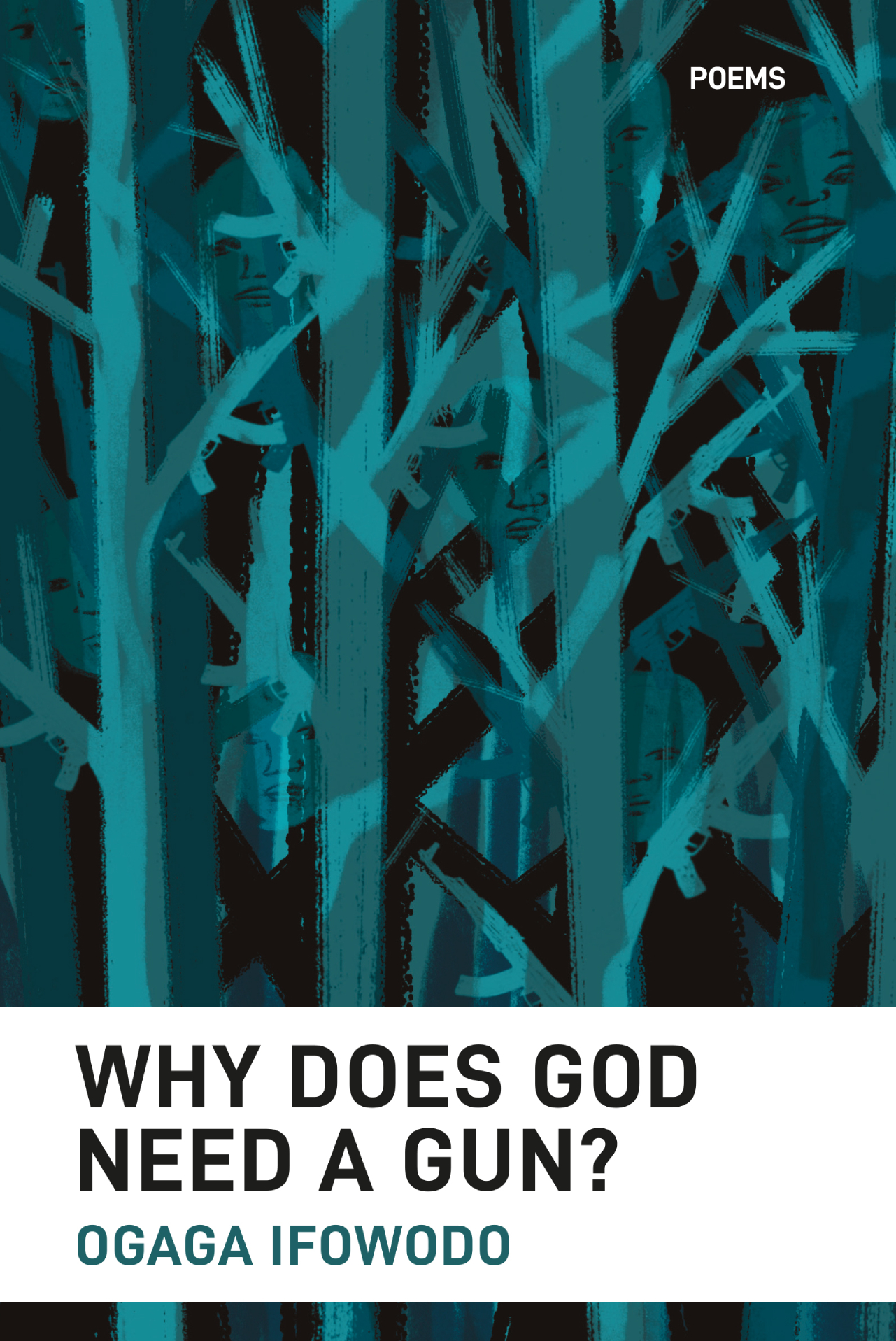
Why Does God Need A Gun?, Ogaga Ifowodo, Masobe Books, 2026, 116 pages
Over the past two decades, there has emerged a growing body of Nigerian literature that deals with the scourge of terrorism, and much of it has earned the recognition of the country’s most prestigious literary honour, the Nigeria Prize for Literature.
Think of titles such as Soji Cole’s Embers, Adaobi Tricia Nwaubani’s Buried Beneath the Baobab Tree, and Linda Masi’s Fine Dreams. Ogaga Ifowodo’s collection joins this corpus, but distinguishes itself by rendering the trauma in the compressed register of poetry.
In a note at the beginning of Why Does God Need a Gun? Ifowodo recalls the 2018 attack by members of the Islamic State West Africa Province (ISWAP) on the Girls’ Government Science and Technical School in Dapchi, Yobe State, in which 110 girls were abducted. Among them was Leah Sharibu, who famously refused to renounce her Christianity and convert to Islam.
Ifowodo’s intention, he tells us, is to make Sharibu the heart of what he calls “my poetic ruminations” on the scale of these tragedies, in an attempt to illuminate, through one girl’s ordeal, the wider malaise of religious extremism within Nigeria.
The collection’s first part, “From the Forest of a Million Demons,” takes its title from the notorious Sambisa Forest, known as the dense stronghold/hideout that Boko Haram and its offshoots have held many of their captives, the Chibok girls among them. It also pays a tongue-in-cheek homage to D.O Fagunwa’s The Forest of a Thousand Daemons.
Here, across thirty-two poems, the poet-persona of Sharibu speaks, offering us an intimate invitation into the mind of a girl whose life has been upended by violent extremism.
The poems in this section accord the terrorists no sympathy whatsoever, holding for them only venom, ridicule, judgement, and mockery, even questioning their place in the world.
 Through a child-like, unapologetic openness, Sharibu’s persona excoriates their brutish ways and regressive conquest mentality. In “I Watched Them Pray, Guns Ready,” she derides them as people with “eyes glazed by a dream of heaven in hell,” cloaked in a feigned piety that earns them grand self-designations: “God’s saviours,” “God’s mind readers,” “God’s guardians.” They are “brave warriors holier than God,” she mocks, before accusing them pointedly: “you created your god that wars and whores in your own image.”
Even God is not spared.
Sharibu’s voice turns on his silence, demanding: “Why do you let false prophets take your name in vain?”
It is worth remembering that the real Leah Sharibu remains the exception among the Dapchi girls: while most of those taken along with her in 2018 were eventually released (a handful having escaped or died in captivity), Sharibu alone has remained in captivity ever since. That reality seeps into poems like “Dear Daddy I Missed You So Much…” and “Will I Ever Hold a Book Again?”, where her voice softens into something closer to grief than defiance, mourning a life left behind, longing to “wear again my old play clothes,” and fearing that her parents “no longer know how to laugh.”
Part Two moves beyond Sharibu’s persona to consider the terrorists themselves, “the gods without whom there is no God.” Its most affecting poem, “Keeping Her Clothes Clean,” gives voice to a mother still holding onto hope that her daughter is alive; a poetic portrait that mirrors the tragic reality of parents who have waited years, denied closure or relief.
Part Three is marked by a spiritual deepening present in meditations that transcend into the supernatural and metaphysical: faith healing, creation myth, womanhood, oneness with nature and “the godhead,” African traditional worship, cult-like mysticism, death, and the afterlife. “Dying to See His Face” gives voice to the human hunger for proof of something beyond ordinary life, while “That’s How We Run Out of Oxygen” restates death as the final existential certainty.
Ifowodo deserves real praise for the intimate style that fleshes out Sharibu’s poet-persona, drawing sustained attention to the cankerworm terrorism has become in Nigeria, particularly its assault on girls’ education and freedom, while immortalizing the memory of a fourteen-year-old whose steadfast faith inspired the world. Yet the first section grows exhaustively repetitive at points, circling the same themes without enough forward motion.
Even so, Why Does God Need a Gun? achieves something noble: the creation and preservation of an important voice. Its poems, dense with lyricism, challenge us never to stop questioning our realities and beliefs, celebrating the boundlessness of human thought and consciousness as the closest thing possible to true divinity.
**Ogaga Ifowodo’s Why Does God Need A Gun? has been shortlisted for the Nigeria Prize for Literature 2026.
***Sima Essien is an award-winning writer based in Uyo, Nigeria.