

By late afternoon on Saturday, September 12, the crowd at Roving Heights Bookstore, Oniru, had the particular hush of a room that knows it is about to be asked to make a confession.
This was the final act of The Lagos Review’s inaugural Writing Weekend, three days of masterclasses on writing music, book, and movie reviews, as well as essays, facilitated by Dr. Eghosa Imasuen, Adewale Maja-Pearce, Oris Aigbokhaevbolo, Akumbu Uche and Toni Kan.
 The full cohort of 15 young reviewers and essayists drawn from across Nigeria featured: Charity Ezeja (Abuja), Deborah Iyalagha (Yenagoa), Hubaidat Ishola (Lagos), Joseph Jonathan (Abuja), Keyukemi Usani (Iperu), Lateefat Balogun (Lagos), Mariam Abdullahi (Abuja) and Azubuike Obi (Awka).
Others were: Ahmad Mubarak Tanimu (Kano), Adewande Oreshade (Abeokuta), Yusuf Zay (Lagos), Sima Essien (Uyo), Shalom Tewobola (Lagos), Seyi Lasisi (Lagos) and Peter Adeyemo (Ibadan).
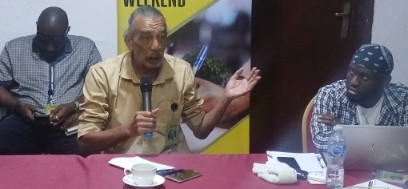 The programme culminated in a public evening of readings and conversation. What was promised as “a public reading” delivered something closer to a reckoning.
The opening readings set the tone unannounced. Eghosa Imasuen read from The Challengers, his account of Nigerian entrepreneurs building billion-naira companies against structural constraints, a fitting overture for an evening fixated on what gets built, and by whom, when infrastructure fails.
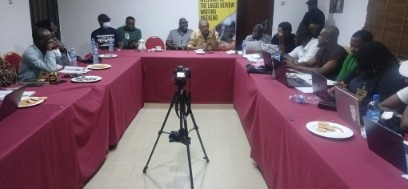 Then came the cohort: Charity read, Azubuike read, and others followed. Those present purely for the literary programme later admitted they missed expecting what followed: a run of raw readings that someone half-in-jest labelled a “day of confessions.”
The centerpiece featured Toni Kan in conversation with Toyin Akinosho, centred on Kan’s Riding the Storm: The Untold Story of Africa’s Response to the COVID-19 Pandemic.
Toni Kan argued that public service failure in Africa is a shortage of initiative, not capability because competence stays idle until ordered.
Drawing on his pandemic-era work with one of Nigeria’s Ministers, running a UNDP hunger/SDG round table straight off arrival, he described daily urgency (televised noon briefings, improvised testing, non-pharmaceutical interventions, and a host of other activities).
Akinosho wondered why crisis competence never built lasting health infrastructure and Kan likened Ebola to a burning roof that forces action, after which “anyhowness” returns. High-performing Ebola responders got international postings while local systems reverted to neglect.
On vaccine nationalism, Toni Kan slammed wealthier nations (naming France, for instance,) for stockpiling nearly expired doses despite Africa’s willingness to pay; Akinosho pushed back, arguing Africa’s real failure is organising native capability (“we are quite capable of messing up on our own”).
Turning to the room of 15 writing weekend participants with a mix of book enthusiasts, the practical question arose: is reviewing/long-form creative non-fiction economically viable given thin markets and weak IP enforcement?
The evening reinforced a shared thesis from two veteran narrative non-fiction writers: unglamorous recurring work, reviews, essays, ghostwritten commissions, isn’t a lesser cousin to the novel, but the financial engine keeping a writing life solvent.