

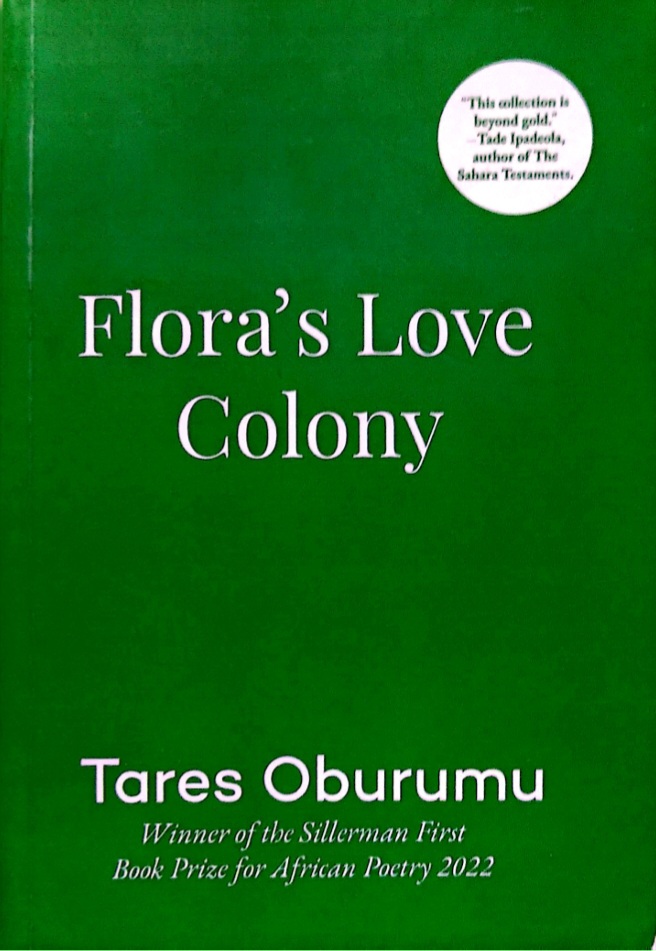
Flora’s Love Colony, Tares Oburumu, Fairchild Media Publishing, 2025, 103pp
To write well, Henri J. M. Nouwen once suggested, is simply to go where it hurts. Tares Oburumu’s Flora’s Love Colony can be taken as a collection born from that precise strain of creative courage.
Oburumu earned a spotlight after he won the 2022 Sillerman First Book Prize for African Poets for his collection, Origins of the Syma Species which was praised for the observational intimacy of its poems. Flora’s Love Colony emerges as a four-part intensification of the elements that made its predecessor special. Oburumu has been described as “a poet whose language stirs the senses,” and it is easy to see why in this collection.
In “Part 1: 1901 & After; The Love of Flora Louise,” Oburumu acts as both witness and avatar, bringing us into hypersensual experiences of pre-colonial and colonial history. The first poem, “Dear History,” flows from biblical intonations into personal testimony, showing us the calm before the storm – the beauty and innocence of pre-colonial lands before the Europeans arrived. When Oburumu writes of “cowries cast in gunpowder,” the imagery that surfaces is a representation of violent colonial disruption.
 In “Opobo, Notebook Island,” Oburumu speaks of a time when “the world was one world,” and in “All Harrow, the Gwaris,” his poet-persona denounces the British, a people who, in the poem “1914,” are condemned to be “wild in oblivion,” capable of only conquering a land whose beauty and history they can never understand. And yet, even in this brutal wake of history, Oburumu reminds us that only tender, soothing love survives.
In this collection, the poet abandons linear perceptions of time for a more cyclical and labyrinthine chronology. In Oburumu’s grasp, history is a constant cycle of actions, events and people. This is why historical figures populate these poems: Lord Lugard, Sir James Robertson, Flora Shaw, Mary Slessor, Joseph Conrad – spectres summoned to reenact their complicity in the past. And like a nomad, Oburumu wanders places: Badagry, Opobo, Ikom, Takwa Bay, Freetown, Syma, Gaza, Oron. In this poetic reach and thematic range, no one is dead and nowhere is distant and nothing is past. Poetry invokes all that is known and obscure.
When we arrive at “Part II: Fusion, the fragments,” the poems put up a tougher resistance to surface-level interpretation, inviting one rather into a celebration of language that walks the balance between cryptic chaos and lyrical rapture. Here, the poet contemplates the paradox of the Nigerian spirit that insists on excellence amidst crippling dysfunction, while still finding solace in family, love, literature and music.
But the troubles of man and society are endless. In the sub-sections of “The Church on No. 2023, Aguleri Street,” “Tripartite” and “Dissertations,” Oburumu grapples with aching grief and loss, casting his gaze upon the violence inflicted upon Christians, with poetic psalms and sobering elegies that examine the aftermath of terrorism. When he asks, “Does history repair?” in “Sun, Burnt,” it is not for an answer, but a plea for the sort of remembrance that keeps the dead alive. Perhaps this is why, in talking about losing loved ones, or on suicidal depression, Oburumu is always seeking a tenderness that survives cruelty.
The poems in “Part III: Exits” meditate extensively on the passage of time, remembrance, post-colonial shadows, racism, migration, identity negotiation, and the Sisyphean paradox of Nigerian life. “Part IV: For Alice” gives us “Name,” which is quite possibly the most beautiful poem in this collection, a paean to family and parental love, as well as a celebration of his beloved mother.
However, for a collection that condemns slavery, colonialism and post-colonial influence as the causal factors behind Nigeria’s dysfunction, there is little reference to how the modern leadership of this country has further compounded our national woes.
This can also be seen in Ogaga Ifowodo’s Why Does God Need A Gun? (which won the Nigeria Prize for Literature for which Tares Oburumu was also shortlisted ), which makes much ado about the evils of terrorism and religious extremism, but sidesteps the glaring ineptitude of governance that has emboldened insurgency for years. By pulling their punches, both Oburumu and Ifowodo, appear as though unable, or unwilling, to go fully in that direction.
But ultimately, the 70 poems in Flora’s Love Colony are undeniably attentive to the pulse of lived experience and history, providing a cartography of pain, longings, grief, trauma, and the sort of tenderness that survives reality itself.
With this collection, Oburumu makes an overwhelming case for his inclusion amongst the canonical rank of poetic voices that he himself was inspired by – Eliot, Okigbo, Clark, Soyinka – as well as a statement for the vitality of contemporary Nigerian poetry.
**Tares Oburumu’s Flora’s Love Colony was shortlisted for the Nigeria Prize for Literature 2026.
Sima Essien is an award-winning writer based in Uyo, Nigeria.