

Bi Ìkú se lágbára tó, kò sí ológún tó lè rí ti kù ṣe (Death is so powerful that no medicine man can ward it off)” — Alhaji Sikiru Ayinde Barrister, Agbara Ìkú Medley (1991)
There is a particular cruelty to the timing of things, and Taiwo Hassan’s life closed on such a note.
Thirty-six years before his own body was carried through the streets of Ilaro to the Asade Agunloye Pavilion, a younger version of him had stood over the grave of Hubert Ogunde, the father of modern Yoruba theatre, and sent him off with chants of oríkì.
In May 1990, Ogogo was one of the voices raised over Ogunde’s burial ground, reciting the praise-poetry that Yoruba culture reserves for its most consequential dead. On August 23,2026, at 66, after a battle with stage-four cancer that his daughters had spent his final weeks publicly pleading for help to fight, that same voice went quiet.
Before Taiwo Hassan became a leading man in movies, long before “Ogogo” was a household name stitched into memes and comedy sketches, he arrived first as a chanter.
He worked as an Akede Oba, a royal praise-singer, the figure whose job in Yoruba performance tradition is to stand slightly outside the drama and locate everyone else within their lineage. It is a role with a deep foundation in the itinerant, open-air performance culture of the Alarinjo travelling theatre, the centuries-old tradition of masked and unmasked mummers, chanters, and satirists who moved from town to town animating festivals and palace occasions long before “Nollywood” had a name.
Hassan trained under the veteran theatre practitioner Awo Ademola Fagbemi, honing his craft on the road in the early 1980s, reciting the eulogies of kings and chiefs.
His own colleagues nicknamed him “Olohun Iyo”, the one with the honeyed voice, a reference to a character in D.O. Fagunwa’s fantasy novel, Ògbójú Ọdẹ Nínú Igbó Irúnmọlè, and Wole Soyinka’s Death and the Kings Horseman before eventually settling on the name that will now outlive him.
“Ogogo” was not an invention for the stage nor a nom de guerre. It was lifted whole from his family’s oríkì, a line of ancestral praise poetry: “Emi Omo Ogogo a ku lodo, Omo ku lomi lomi,” that he had recited about himself and others since childhood. His fellow actors caught and began teasing him until it stuck.
It is worth emphasising that origin, because it explains something about the actor he became. A praise-chanter’s whole discipline is built on control in service of intensity. In Yoruba traditional theatre, one does not act out the king’s greatness but simply speaks it, cleanly, allowing the seriousness of the words do the work.
That grammar of the itinerant theatre followed Hassan onto film sets for the next four decades. Long after he had become one of the most recognisable faces in Yoruba-language cinema, critics and colleagues kept circling back to the same observation: Ogogo’s acting never tipped over into spectacle. He specialised in men who did not need to raise their voices to be believed: the calm patriarch, the composed chief, the principled elder holding a room together while everyone around him frayed.
Even in roles engineered for menace or grief, he tended to underplay, trusting a lowered vocal register and a level gaze to hold more threat, or more sorrow, than a raised fist ever could. Audiences who came to Yoruba films expecting the operatic and the spectacular – and Yoruba cinema has never been shy of those – sometimes waited for Ogogo to erupt. He rarely did. That refusal became its own kind of signature.
Before he built a career, acting was a hobby woven around a day job. Hassan trained as an automobile mechanic at Yaba Technical College and later worked for the Lagos State Water Corporation, building his theatre life on evenings and weekends until 1994, when he finally resigned from the civil service to commit to acting full-time. He made the decision just as Nigeria’s home-video boom was gathering the momentum that would remake Yoruba popular theatre into an industry.
Two years later came the film that turned a respected stage and video actor into a national name. Tade Ogidan’s 1996 classic Owo Blow, a cautionary tale about the seduction and ruination of quick money that became one of the defining Yoruba films of its era. Hassan’s performance in it earned him a THEMA (The Movie Awards) Best Actor award the following year and installed him, for good, in the country’s living room.
What he did with that visibility is arguably the more durable part of his legacy. Alongside his longtime friend and collaborator Yinka Quadri, and Abbey Lanre, Rasaq Ajao, and Alade Aromire, Hassan co-founded the Odunfa Caucus, a theatre and production fraternity that functioned, informally but unmistakably, as a film school without walls. Though devoid of the generic school settings, there was a working set, a community of older actors willing to correct a young performer’s delivery, and a culture of apprenticeship that Yoruba cinema had inherited from the travelling-theatre companies of Ogunde and Duro Ladipo’s generations.
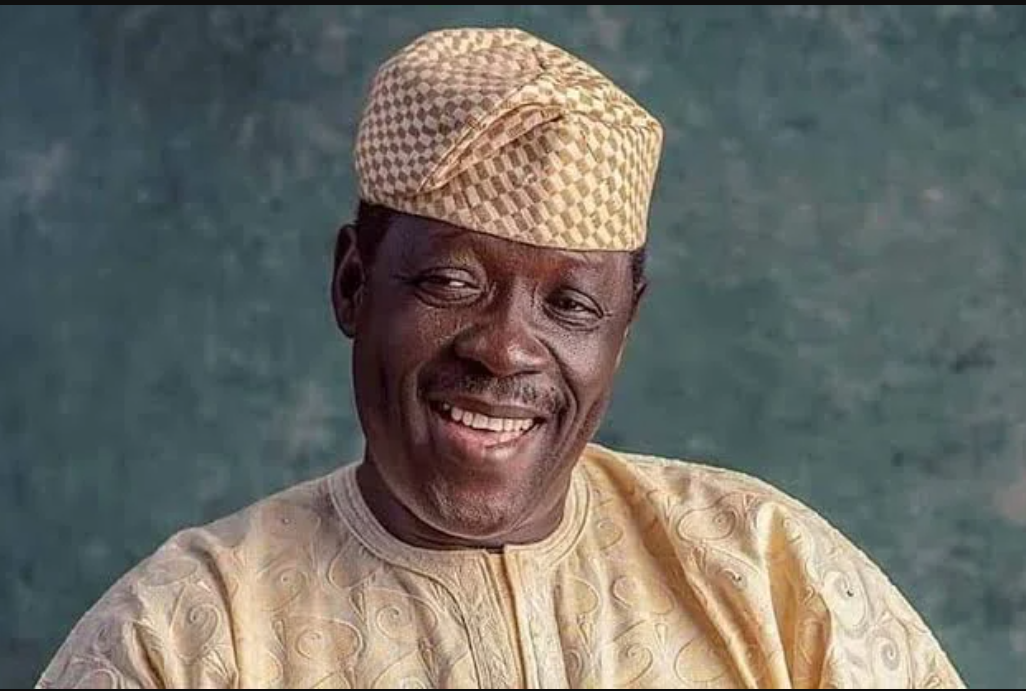 A startling number of the actors who now define Nollywood’s Yoruba-language wing passed through the Odunfa Caucus: Funke Akindele, Fathia Williams (Balogun), Yomi Fabiyi, Iyabo Ojo, Bimbo Thomas among them, each arriving green and leaving with the instincts of the trade. It is one thing to be a star; it is another to spend decades quietly building the foundation that produces the next generation of stars.
Hassan did both.
There was also, unavoidably, the persona. Hassan had a boxer’s build, the handsome, weathered face, the composure that colleagues describe as extending well past the camera into how he carried himself off set, even in genuinely tense or dangerous situations on location.
And there was the catchphrase, delivered in that same unhurried baritone, that became inseparable from his screen presence: “Wallahi Tallahi, mo fi títóbí Olórun Ọba búra”. Roughly translated, it’s an oath sworn on the very greatness of God.
It was a line he varied and redeployed across roles until Nigerians started swearing it themselves, half in jest, half in tribute, in ordinary conversation. Alongside it sat his other bit of slang: “Gbogbo wa la máa jẹ breakfast (We will all, eventually, be heartbroken or played by a lover)”. It was later taken into pop stratosphere by Burna Boy through his heartbreak song, “Last Last”.
Who would have thought that a phrase Ogogo tossed off in a Yoruba film, half-joking, half-wise, ended up travelling farther than most of his scripts ever did, outliving the plot, the character, even the memory of which film it came from, until it was riding a Grammy-nominated hit into clubs and playlists an ocean away.
Few actors get to watch their throw-away lines become Urban Idioms while they’re still alive to hear strangers say them back. Ogogo did, twice over, once with an oath sworn on God’s greatness, and next with a joke about heartbreak.
Ogogo had a vast filmography where he played diverse characters to the delight of the audience. Besides his roles in old movies like Owo Blow, Agbelebu, and Ọmọ Ghetto, many people will remember him for his role as Alaafin Ademuyiwa in Kunle Afolayan’s Aníkúlápó series, the 2022 Netflix film that became one of the most discussed Nigerian productions of its year and introduced Ogogo, all over again, to viewers who had never seen Owo Blow and had no memory of the Odunfa Caucus.
The performance earned him a Best Supporting Actor nomination at the Africa Magic Viewers’ Choice Awards. It was a fresh accolade that arrived nearly three decades into a career that had already made him a legend, proof that his peculiar poise translated across formats, across generations, across the gap between home video and streaming.
What he leaves behind resists a tidy inventory. There is a training ground disguised as a friendship between actors who decided to bring others up with them. There is a catchphrase people still swear by without remembering where it came from. There is the specific, disciplined calm of a man who understood, perhaps from all those years standing beside kings, chanting their names instead of playing them, that presence does not require noise.
In April 1990, he stood over Hubert Ogunde’s grave and sang the old man into the ancestry. Thirty-six years later, in Ilaro, he set forth and became an ancestor.
O dabọ, Ògògó a ku lodo, Ọmọ ku lomi lomi.
**Michael Kolawole is a screenwriter, playwright, poet and cultural journalist/critic. Catch him on X @mykflow