

Michael Agyapong, Where Shadows Gather, Masobe Books, 2026 260pp
Crime stories hold us less for the criminal act itself than for what it leaves behind: the ripples that move through families and communities. Add a persistent dread, and the result is a book that stays with the reader long after the case is closed.
Michael Agyapong’s debut, Where Shadows Gather, braids the two into something distinctive. It opens in an atmosphere of foreboding. A madman comes upon a dead body and utters an ominous warning. We then meet Constable Commodore Kobina Quartey, known as Comm, who “wasn’t a superstitious man, not really…” and yet “every morning, without fail, he prayed…” A man who prays like that is a man waiting to be tested, and so it feels like fate’s cruelty when he is pulled into a murder he wants no part of, with a newborn baby’s life at stake.
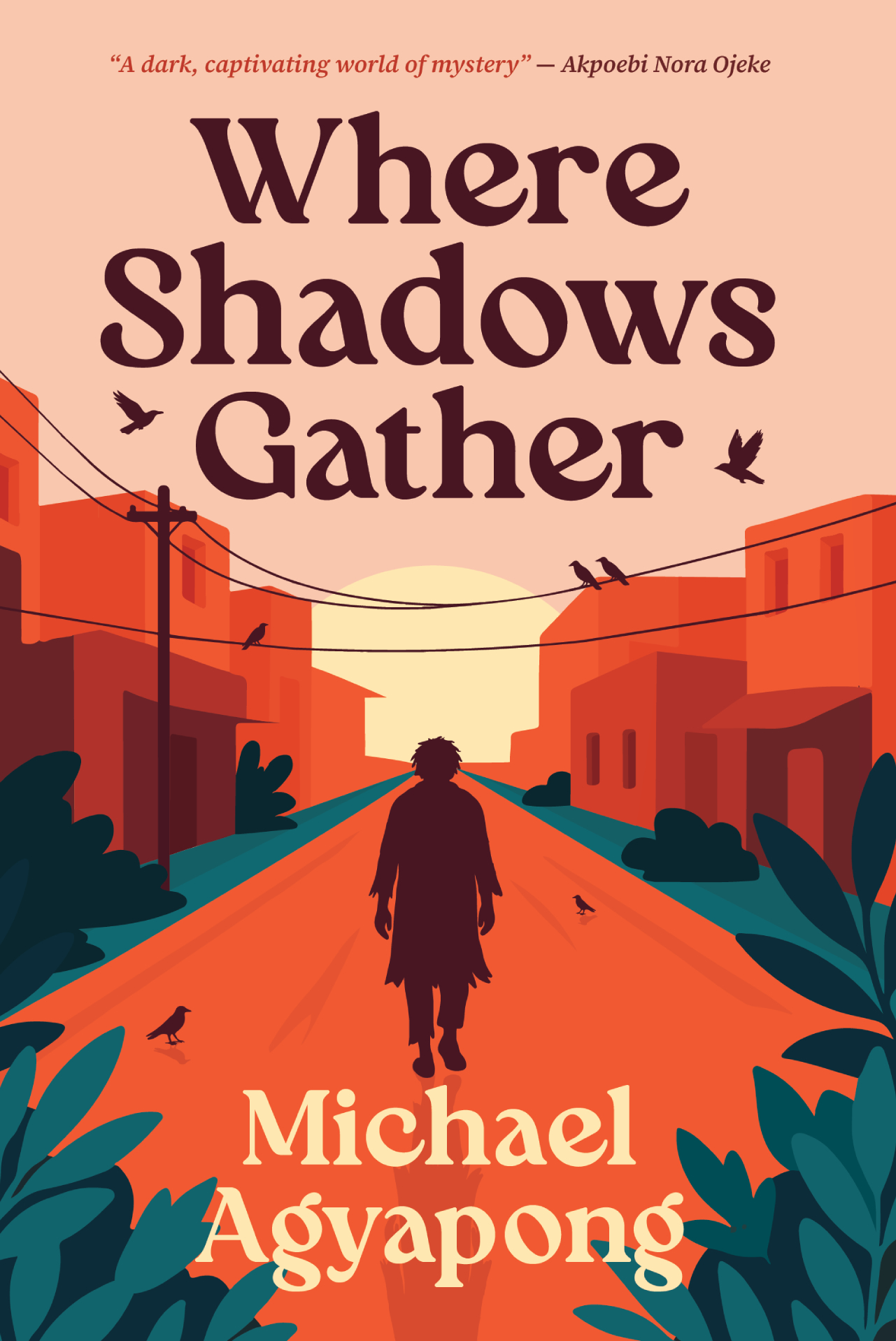 As Comm investigates, the novel shows us a Ghana where religious fanaticism and superstition are intertwined. Ghosts, juju, “money rituals,” and other diabolic practices are, for the average character, matters of settled conviction. Agyapong gives Comm’s reluctance its roots through flashbacks to his family background. His father—also a police officer—died in active service, and Comm has answered that legacy with restraint: “He let sleeping dogs lie…” and “avoided confrontation as much as he could.”
The novel is divided into three parts, and across all of them, detective work comes forth as a pleasure. Comm sinks into a rabbit hole of suspicions, clues, red herrings, and dead ends, probing at the line between truth and lies. But the novel is not only his. Chapters from his perspective alternate with those of the madman, and these build a background history of grief, pain, and loss. By Part 3, we learn that the madman is drawn by a strange force to the dead and dying, and, as if answering an instinctive calling, he buries those who have no one to bury them. The compulsion is penance for lives he ended years earlier. As for the woman accused of witchcraft, Agyapong opens up her fractured mind through short notes.
The madman has a name, Mishael, and the kind of loss that has undone him is said to be so strong that it “unravels a person.” By giving him a name and a past, Agyapong makes a quiet argument for humanizing the mentally ill, for looking past a condition to the person who existed before it.
Agyapong’s greatest gift is the paced build-up, essential to any story that trades in horror and mystery. What makes the book more than competent is its misdirection. We are led, at first, to believe the events are supernatural. We think of blood rituals, witchcraft, demonic possession, and juju. Then Agyapong pulls the rug from under our feet and takes those beliefs apart. In African societies, as in many others, there is often a pull toward explaining terrifying, traumatic, and mysterious events with the supernatural. When Comm questions a group of taxi drivers, the theories he is offered are rooted not in logic but in fear. Agyapong patiently unravels these assumptions, reminding us that the real terrors are rarely demons or witchcraft. They are real troubles that demand urgent social attention. Only by understanding what actually matters can we help the people who need assistance, love, and care.
That is where the novel is boldest. By raising mental health, suicidal depression, and social stigma, Agyapong exposes how poorly our systems cope with a problem that affects so many. He also shows why turning to the church for answers only makes things worse. The detective story becomes an argument: by relentlessly pursuing the truth, we can dismantle the stereotypes and fearful superstitions that keep us from reaching the root of the matter.
The book is not flawless. Agyapong plays it safe in the final stretch, and the closing sequences end up being a bit predictable. At times, the dialogue feels flat and formulaic. But the prose is beautiful and absorbing, especially when it captures the vibrancy of life in Ghana or enters the minds of its characters, and it more than balances those faults.
Readers of Ghanaian fiction know Yaa Gyasi, Nii Ayikwei Parkes, Ayesha Harruna Attah, and Kwei Quartey. With this assured and carefully crafted debut, Michael Agyapong joins them as a distinctive new voice, one writing socially relevant, thematically rich, and thrilling stories. Where Shadows Gather is a solid debut that marks him as a writer to watch in Ghana’s fast-evolving literary landscape.
**Sima Essien is an award-winning writer based in Uyo, Nigeria.