

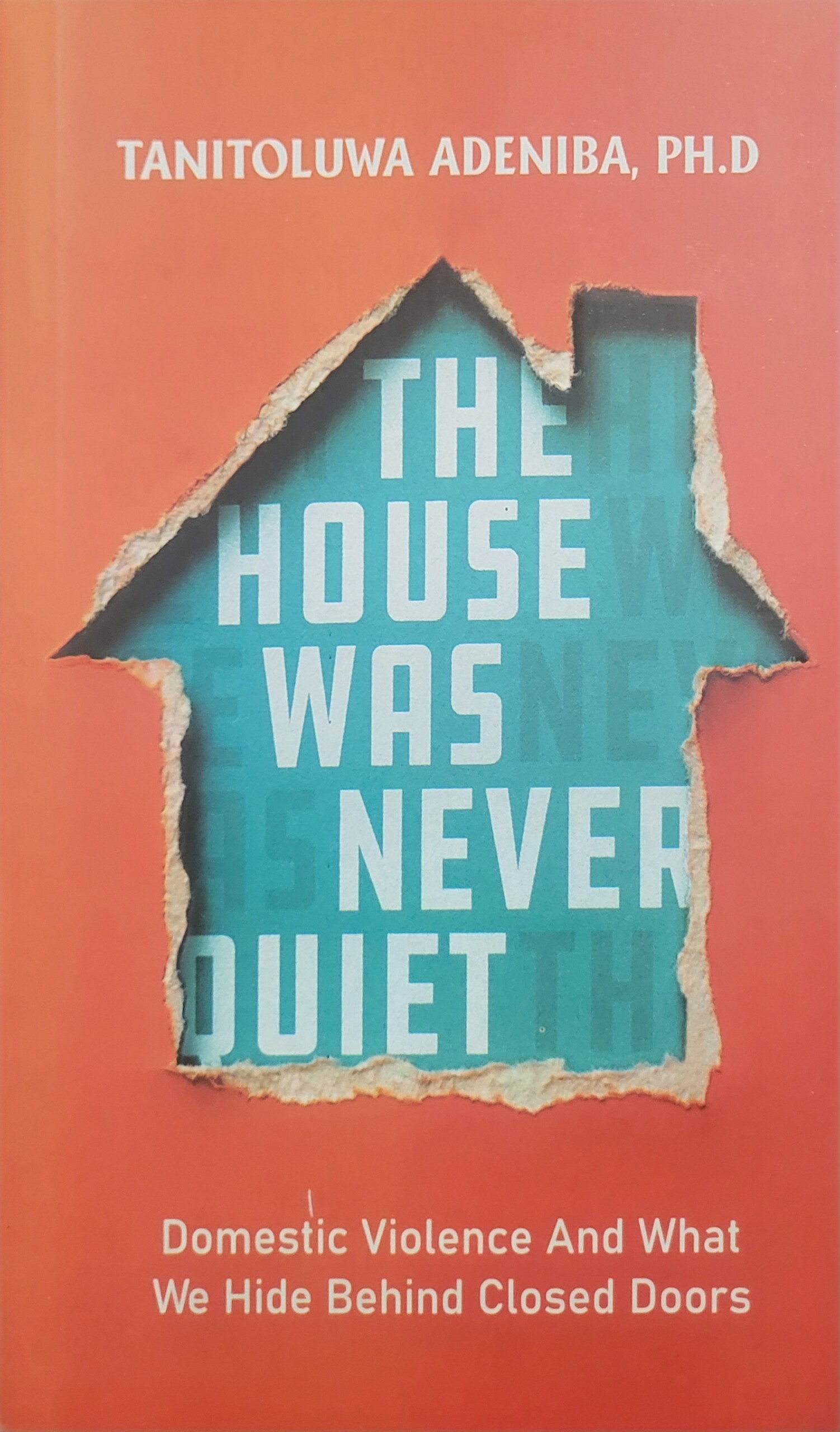
‘The House Was Never Quiet’ by Tanitoluwa Adeniba, Parresia Books, 2026
Tanitoluwa Adeniba’s nonfiction, ‘The House Was Never Quiet’, has a subtitle: ‘Domestic Violence And What We Hide Behind Closed Doors’.
The subtitle provides clearer insight into this remarkable work about the violence in millions of our homes, the violence that we, almost all the time, prefer to explain away in ways that are, at best, defeatist.
Adeniba, a US-based family researcher, examines all the facets of this disaster that continues to defy us. In the book, she shows us what causes it, what sustains it and how, if we are serious, it can be drastically reduced, if not eliminated.
The book, which is divided into thirteen chapters with Forewords by Bishop Funke Felix-Adejumo and Lagos State Domestic and Sexual Violence Agency (DSVA) Executive Secretary Titilola Vivour-Adeniyi, shows us how refusing to call a spade a spade helps domestic violence to metastasize .
While not disputing the fact that men can and have been victims of domestic violence, she emphasises the fact that women are disproportionately affected. She discusses the fact that mothers can be complicit while the men they call husbands, the fathers of their children, are the culprits.
 Using true life stories of the several women she interviewed – whose identities are concealed for their safety – Adeniba humanises her narrative.
We see how women, who have been repeatedly told ‘I’ll kill you one day’ by men who claimed to have loved them, usually end up dying months after the threat is issued.
The book calls out culture and its role in empowering abusers and making the abused choose silence. She tells us that many cultures downplay domestic violence by giving it colouration that makes it look like something less evil. Some of these cultures see it as discipline and others dress it as the patriarch administering corrective measures. She does not spare the religious groups for their roles in pushing for the sanctity of marriage even in the face of domestic violence.
The author tells us that abuse does not always leave bruises or raised voices. It takes the form of control powered by fear and defines what is allowed, what is not allowed and what freedom the party on the receiving end enjoys. This type of abuse, the author shows, is not often considered abuse and women do not call it violence. Her research shows that more women deal with this situation, which are explained away as marital issues. But, she calls it what it is: emotional and psychological abuse.
The writer says that in homes where the mothers are either physically or emotionally abused, the children absorb tension, which has long-term effects on their personalities. “Parenting under these conditions creates a strain that is rarely acknowledged but deeply felt,” she writes.
Adeniba touches on how leaving the abusers can be difficult for women because of the fear of starting all over again, because of economic pressures and because of how our society sees women who dare to leave.
She delves into the questions women ask themselves when they are confronted by the decision of leaving. Children, societal expectations and the fear of the unknown play critical roles in making them stay with men who have turned them to punching bags, men who are likely to end up killing them or inflicting permanent disabilities on them.
Adeniba’s book advocates that domestic violence requires more than policy and enforcement to be curbed. Confronting the beliefs and norms sustaining abuse, she strongly argues, is germane to taming this evil. She also emphasises creating environments where survivors are safe to speak, seek help, and rebuild their lives.
She acknowledges the role of friends, neighbours, and community members who are the support systems for women navigating this difficult terrain.
Though it points out the roles of faith and culture in abuse cases, ‘The House Was Never Quiet‘ does not call for their rejection. It simply seeks a critical examination of how these bodies almost, in equal measure, support and constrain women. The book seems to be saying that traditions must be refined to promote dignity, safety, and equality. It also asserts that it is high time religious groups saw the protection of the vulnerable as their most important message.
By including what she calls ‘action box’ and ‘discussion prompts’ at the end of each chapter, the author seeks to take the fight against abuse further to the classrooms and focus groups.
This important book will leave you with questions about the kind of homes we are building and the values we are transferring to the next generation.
***Olukorede S. Yishau is the author of two novels: In The Name of Our Father and After The End; a collection of short stories: Vaults of Secrets; and a travel book: United Countries of America and Other Travel Tales. His third novel, Black Market, is forthcoming from Masobe Books in the last quarter of 2026. He lives in Houston, Texas.