

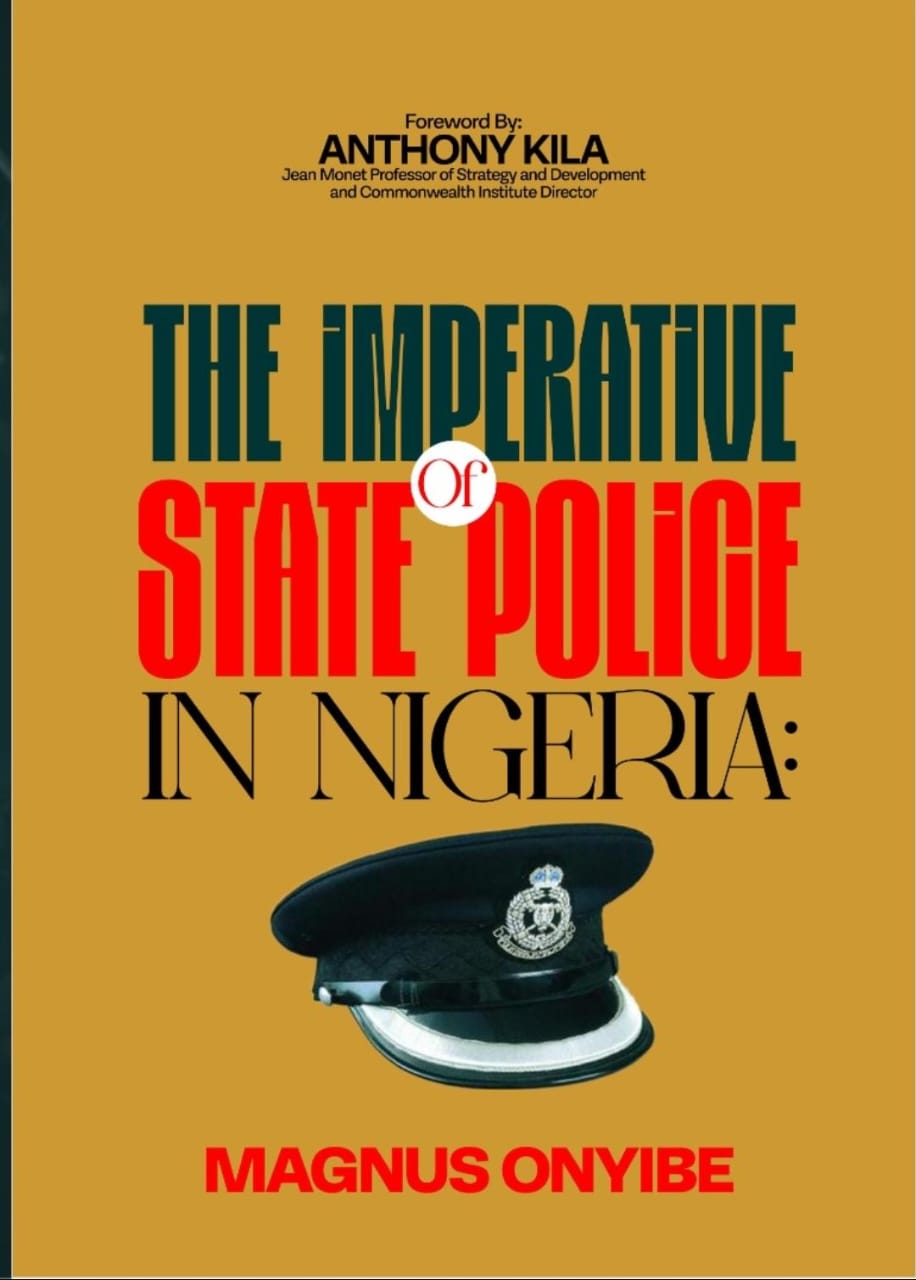
There are books which arrive because their authors have something to say, and there are books that arrive because a country has reached a point at which something needs to be said. Magnus Onyibe’s The Imperative of State Police in Nigeria belongs firmly in the latter category.
It is a topical book because it addresses one of the most consequential questions in Nigeria’s contemporary public-policy debate: can a country as vast, populous, diverse and security-challenged as Nigeria continue to rely almost entirely on a policing architecture centred on centralised control?
But the book’s significance goes beyond its position on state policing. Its real strength is that Magnus Onyibe does not treat policing simply as a question of law enforcement. He treats it as a question of institutional design, federalism, governance, intelligence, technology, accountability, and the relationship between the state and its citizens.
Please allow me to point out why this distinction matters.
The debate over state police has too often been reduced to a binary argument: supporters are portrayed as advocates of decentralisation, while opponents are presented as defenders of national unity. Onyibe’s book is more sophisticated than that. It recognises the legitimate fears surrounding state police while asking whether those fears should permanently prevent institutional reform.
 Indeed, one of the book’s most important propositions is that institutions should be judged by their capacity to solve the problems they were created to address. Nigeria’s security environment has changed profoundly, and the author asks whether the architecture designed for an earlier Nigeria still fits today’s Nigeria.
That, in my view, is the right question.
One of the book’s most useful contributions is its historical reconstruction of how Nigeria moved from a relatively decentralised policing arrangement to the highly centralised system that exists today.
Onyibe reminds the reader that state or regional policing is not an alien institutional idea imported from elsewhere. Nigeria had regional and local police organisations before and during the First Republic. The present arrangement emerged largely from the extraordinary circumstances surrounding military intervention, political instability, and the Civil War.
This historical dimension matters because it shifts the terms of the debate. The question is not simply “Should Nigeria experiment with state police?” It is also “Why did Nigeria abandon decentralised policing in the first place, and are the circumstances that produced that decision still applicable today?” That is a much more intellectually productive question.
The author captures the issue with a particularly useful formulation: “Stability should never be confused with permanence, nor continuity with effectiveness.”
That sentence deserves to travel well beyond the pages of this book. It applies not only to policing but to public institutions generally. The fact that an institutional arrangement has survived for decades does not, by itself, prove that it remains appropriate.
The central operational argument for state police is equally compelling.
Crime is often local before it becomes national. Security threats emerge in communities, forests, neighborhoods, waterways, markets, farms, and transport corridors. Effective policing therefore requires knowledge of geography, language, social networks, customs, and local patterns of behavior.
Onyibe argues that decentralisation can improve intelligence, reduce bureaucratic delays, and make policing more responsive to local conditions.
This is particularly relevant in a country where the security challenges in one region can differ radically from those in another. The book examines these differences and argues for policing strategies that can respond to distinct regional realities rather than imposing a uniform operational model across the federation.
There is an important strategic principle here: different problems require different forms of institutional response.
A policing architecture that treats insecurity in the Niger Delta, banditry in the North-West, insurgency in the North-East, communal conflict in the North-Central and metropolitan crime in the South-West as variations of the same problem will inevitably struggle to optimise its response.
What makes this book more useful than a conventional advocacy text is that Onyibe does not pretend that state police is risk-free. The danger of political interference is real, and he acknowledges it.
Political actors could abuse a state police structure. It could become an instrument of intimidation, partisan enforcement, or electoral manipulation. The history of the First Republic cannot simply be wished away.
Onyibe’s response, however, is not to dismiss these concerns. It is to ask whether they can be institutionally managed. That is where the book becomes a work of policy design rather than mere advocacy.
Magnus Onyibe argues for constitutional safeguards, independent oversight, judicial review, legislative supervision, civilian complaints mechanisms, financial transparency, national professional standards, and effective coordination between federal and state police organisations.
The proposition is straightforward: “The appropriate response is therefore not to preserve an arrangement that is increasingly struggling to meet Nigeria’s security needs, but to design constitutional guardrails that minimise abuse while preserving the benefits of reform.”
This is a very important intellectual discipline in the book: recognising a risk without allowing the mere existence of risk to serve as an argument against possible reform.
Another commendable feature of Onyibe’s argument is his rejection of the false choice between federal policing and state policing.
 He does not propose thirty-six disconnected police organisations operating as independent security kingdoms. Rather, he envisages a system in which federal and state policing responsibilities coexist within a common constitutional framework.
That distinction is critical. A mature federal system does not require every level of government to perform identical functions. It requires clarity of responsibility, coordination, and accountability.
As the author puts it: “The real challenge before Nigeria is to design a policing institution that combines local operational flexibility with national coordination, democratic accountability and the rule of law.” That is a proposition with considerable policy merit.
The book also deserves commendation for refusing to make state police the entire answer.
Its later chapters broaden the discussion into technology, intelligence, traditional institutions, community participation, criminal justice, and inter-agency coordination.
This is particularly important because modern policing cannot depend exclusively on the number of officers carrying weapons.
Technology can improve surveillance and intelligence. Communities can provide information and context. Traditional institutions can contribute local knowledge and early warning. A functioning criminal justice system can ensure that policing ultimately leads to credible justice.
Onyibe captures the principle well: “Technology can enhance intelligence, but it cannot generate trust.” That is a profound observation.
Nigeria’s security challenge is, therefore, not merely a question of who controls the police. It is also a question of how information flows, how institutions cooperate, how communities participate, and how authority is held accountable.
The author’s treatment of technology, including the discussion of intelligence-led policing and the Enugu experience, gives the argument a welcome contemporary dimension.
Perhaps the greatest virtue of The Imperative of State Police in Nigeria is that it moves the conversation from slogans to institutional questions. It asks us to consider not simply whether we support or oppose state police, but how it should be designed? Who should supervise it? What should the federal police do? What should state police do? What safeguards should exist? How should intelligence be shared? How should funding be regulated? How do we prevent political capture? How do we measure effectiveness? How do we preserve national cohesion while bringing security closer to the people?
These are the questions that serious policy conversations should address. The book’s concluding proposition is, therefore, particularly significant: “The imperative of state police is not simply the imperative of establishing another tier of policing.”
Exactly!
The real issue is whether Nigeria can redesign its security architecture to become locally responsive, nationally coordinated, and democratically accountable.
That is a much bigger ambition than creating another police organisation.
Magnus Onyibe deserves commendation for taking on a subject that is both politically sensitive and institutionally complex and for doing so with a commendable willingness to examine the argument from multiple sides.
The book is historical without becoming trapped in history. It is policy-oriented without becoming technocratic. It supports decentralised policing without ignoring the dangers decentralisation may create.
Most importantly, it invites Nigerians to reconsider a habit that has become common in our public life: mistaking inherited arrangements for permanent truths.
Nigeria’s security challenges have evolved. Its population has expanded enormously. Its cities have changed. Criminal networks have become more sophisticated. Technology has transformed both crime and policing. The institutional response must, therefore, evolve as well.
This is why I consider The Imperative of State Police in Nigeria a timely and useful contribution to Nigeria’s continuing constitutional, security, and governance conversation.
 It should be read by policymakers, legislators, security professionals, academics, civil society organisations, traditional leaders, journalists, and, indeed, citizens interested in the future of Nigeria’s federation.
Its greatest achievement may ultimately be that it does not ask the reader to agree with state police; it asks the reader to think seriously about how Nigeria should police itself.
And that is a conversation Nigeria can no longer afford to postpone.
Thank you very much.
***Prof. Anthony Kila, a Jean Monnet Professor of Strategy and Development and Director of the Commonwealth Institute presented this review at the public presentation of the book, The Imperative of State Police in Nigeria by Magnus Onyibe in Abuja on September 10, 2026.