
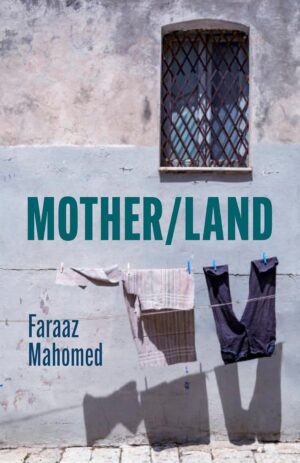
Mother/Land, Faraaz Mahomed, 2026; Catalyst Press, pp 285
Mother/Land, the debut novel from the South African author Faraaz Mahomed, opens with a reference to Rhodes Must Fall, the protest movement that kicked off in March 2015 at the University of Cape Town after the activist Chumani Maxwele launched a bucket of human waste at a statue of Cecil Rhodes, the 19th century British industrialist and an emblem of white supremacy.
Salim, one of the novel’s three narrators, is in New York at the time of the incident, yet “even thousands of miles away” as he puts it, “the furrowed anger tossed at minted metal” feels palpable to him.
Salim is Coloured, a South African ethnic designation for a group of people with multiracial ancestry who were marginalised under apartheid rule, and as some would argue, even well after. By contrast, in the United States, where Salim has moved for economic freedom, the term is considered outdated and offensive, yet his immigrant status, mixed heritage, and familial affiliation to Islam perpetually mark him out as the ‘other.’
 Already involved in Black Lives Matter protests and an astute observer of racial and class dynamics, Salim’s own racial reckoning deepens when he discovers a family secret and learns that his biological father was Carl Lamprecht, an Afrikaner nationalist and apartheid promoter responsible for the Group Areas Act of 1966 which forcibly evicted over 60,000 Coloured residents, including Salim’s family, from multiracial neighborhoods and relegated them to urban ghettoes. Meeting his Afrikaner half-siblings complicates matters and introduces friction into his marriage to Nahya, a Muslim feminist whose own family’s displacement from Eritrea is obliquely mentioned.
One of the novel’s other two narrators is an omniscient commentator who presents readers with the youthful perspective of Sawligha, Salim’s mother as she conducts an extramarital affair with Lamprecht between 1965 and 1966, while the other is Aa’isha, Salim’s eight-year old daughter trying to make sense of a confusing world.
Children’s perspectives in adult novels can be tricky to execute; done poorly and they can be too precocious or too naive for credulity, but done well and the contrast of their innocence with their environment underscores the absurdity of the adult world. Mahomed’s inclusion of Aa’isha’s viewpoint achieves the latter, especially given how it portrays the futility of her parents’ attempts to create different life outcomes for their offspring before resigning themselves to equipping her with a social conscience instead.
The forward slash in the book’s title is a clever pun suggesting the two-fold manner in which the story is told — at once a reference to both parent and homeland, and discourse on what children and citizens stand to inherit from either.
All things considered, the novel is strongest when it turns its gaze on apartheid. In the post-apartheid era, it is tempting to think of apartheid as an unfortunate chapter now firmly consigned to the history books. “Wat verby is, is verby,” President Nelson Mandela famously proclaimed shortly after his 1994 inaugural address. What is past is past. But Mahomed’s book implies otherwise. A return visit to South Africa to see his legal father gives Salim an opportunity to observe his birth country without the romanticised filter of diasporic longing, whilst affording the young and impressionable Aa’isha a glimpse of a complex society as similar to as it is different from America. What is clear to both is that underneath the facade of the Rainbow Nation, old fissures remain.
Mother/Land is in good company with books like J.M. Coetzee’s Disgrace, Damon Galgut’s The Promise, and Zoë Wicomb’s Playing in the Light, notable South African novels which lay bare the country’s post-apartheid anxieties, in their own fashion. Mahomed’s writing—intelligent, considered and highly literary—stands toe-to-toe with these greats, and one does not have to read for very long to see why he was awarded a regional Commonwealth Prize in 2016 for his short story The Pigeon and shortlisted for the 2021 Afritondo Short Story Prize. Nevertheless, hardcore fans of realism who can only stomach suggestions of the supernatural in microdoses will bristle at the frequency of ghost sightings and transtemporal interactions in the book.
To return to the events of 2015 that inspired the novel’s plot; the fecal smear on the Rhodes statue at the University of Cape Town was later cleaned, and the statue itself was eventually carted off the campus, but as Mahomed shows in this novel, apartheid is not just confined to a bygone era; its legacies, material and nonmaterial, linger like an indelible stain.
In Mother/Land, as in life, the future is tense, and the past is always present.
***Akumbu Uche is a writer and storyteller from Nigeria. A regular contributor to thelagosreview.ng, her work in arts journalism and cultural criticism has also been published by Cultbytes, IMPULSE Magazine, The Nation, New African Magazine, Service95 and Strange Horizons. Follow her on X.