

Some men spend their lives telling stories. Others become the stories generations will continue to tell. This is the story of one such man.
On March 7, 1947, in Zaria, in what was then Northern Nigeria, a boy was born into a country still under British colonial rule. His name was Pete Edochie.
He was born into a world that was changing, a country negotiating its identity and a society where history, tradition and oral storytelling remained important parts of everyday life. His ancestral roots, however, were firmly planted in Akamnato, Ifite Nteje, in present-day Anambra State.
Nobody could have predicted that this boy would eventually become one of the most recognisable faces in African cinema. There were no cameras waiting , no scripts bearing his name and no audiences anticipating his arrival. There was simply a young boy growing up, attending school and gradually discovering the world beyond his immediate surroundings.
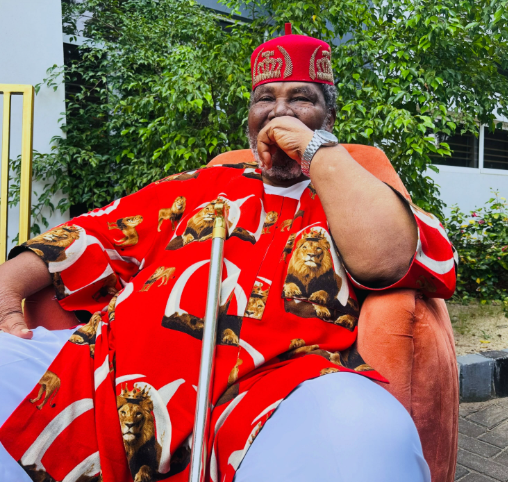 He attended St Patrick’s and St James Primary Schools in Zaria before proceeding to St John’s College, Kaduna. His educational journey would eventually take him to England, where he studied journalism and television.
But perhaps the most interesting part of his journey was that acting was not where his professional story began.
In 1967, at just 20 years old, he joined the Eastern Nigerian Broadcasting Corporation as a junior programmes assistant. What followed was a broadcasting career that exposed him to different dimensions of communication, theatre and performance.
He eventually rose through the ranks at the Anambra Broadcasting Service, serving as Director of Programmes and holding senior management positions.
During those years, he developed an appreciation for language, classical literature and the discipline of performance. He had previously participated in Shakespearean productions, including The Merchant of Venice and Julius Caesar.
In a 2022 interview with TheWill Downtown, he reflected on those experiences, explaining that he had performed Shakespeare long before his transition into mainstream film acting.
Then came the character that would change his life.
In 1985, an opportunity emerged to interpret one of the most significant characters in African literature. Chinua Achebe’s Things Fall Apart, published in 1958, was being adapted for television by the Nigerian Television Authority.
The character was Okonkwo.
A man whose ambition was inseparable from his fear of weakness, whose understanding of masculinity was shaped by his father’s perceived failures and whose attachment to tradition would ultimately contribute to his tragic downfall.
Pete Edochie became that man.
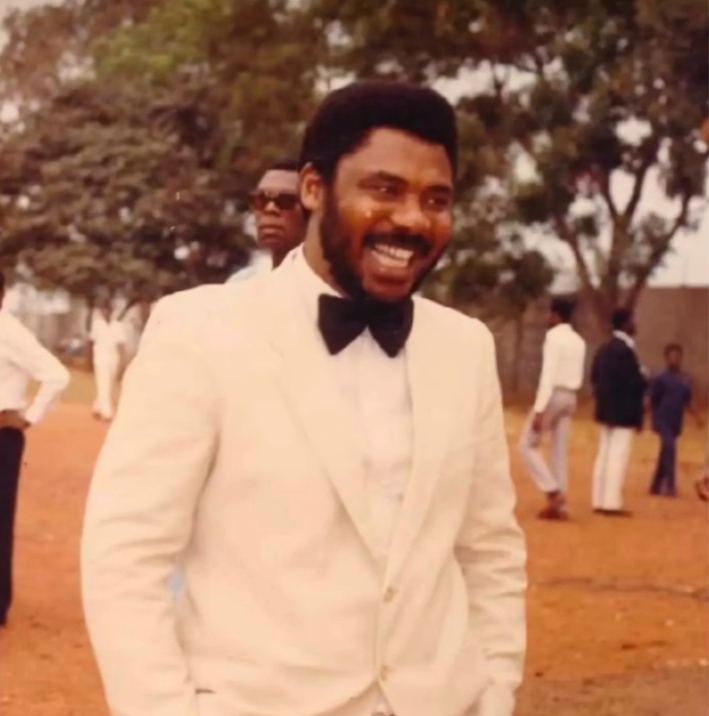 When the television adaptation reached audiences in 1987, his interpretation of Okonkwo became a defining moment in Nigerian television history. He did not simply embody the character’s appearance; his fierce mien, booming voice and tactile presence captured Okonkwo’s contradictions, temperament and internal struggles.
It was as if Chinua Achebe had seen him before creating the character.
In a 2014 interview with Saturday Tribune, he recalled receiving what he considered the greatest compliment from Achebe, who reportedly said that he had given Things Fall Apart an interpretation after his heart.
The production also attracted international attention, with the BBC travelling to Nigeria to interview him about his performance.
But the story was only beginning.
As Nigerian home-video filmmaking expanded during the 1990s, Edochie became one of the actors whose presence helped define the industry’s identity.
He appeared in productions that explored power, tradition, family, spirituality, greed and the complexities of African society.
In Rituals (1997), he portrayed Don Pedro, a character associated with the disturbing intersection of political ambition, secret societies and ritual practices.
In Igodo (1999), he became part of an adventure steeped in African mythology, community survival and traditional belief systems.
In Billionaire’s Club (2003), he explored the darker relationship between wealth, influence and the pursuit of power.
Other notable productions in his filmography include Heavy Battle, Test Your Heart, Greatest Harvest, Secret Pain, Fair Game and Foreigner’s God (2019).
Then came Lionheart (2018), Genevieve Nnaji’s directorial debut, in which he played Chief Ernest Obiagu, a patriarch whose family and company sit at the centre of the story. The film became Netflix’s first Nigerian original film, introducing another generation of international audiences to his work.
Across these productions, a particular screen identity emerged.
He became the wealthy father, the traditional ruler, the uncompromising patriarch and the man whose entrance often changed the atmosphere of a scene.
His deep voice and commanding expression became almost impossible to separate from the characters he portrayed.
Yet, there was something more interesting about his performances: his proverbs.
In that same 2014 interview, when asked whether the proverbs in his movies were scripted or came from his personal repertoire, he laughed and answered:
“They come from me.”
It was a revealing response. His relationship with language was not merely theatrical. He considered it an essential part of his identity as an actor.
He also described himself as a lover of linguistic decency, explaining why he rejected scripts that relied excessively on vulgar expressions.
“I enjoy doing it,” he said of acting, making it clear that his participation in filmmaking was driven by passion rather than lucre.
Perhaps one of the most remarkable things about Edochie’s career was his ability to remain culturally relevant across generations.
The VHS generation knew him. The DVD generation grew up watching him. And the streaming and social media generation discovered him through memes, skits, reaction videos and countless recreations of his familiar expressions.
His voice became a cultural reference point.
You could find his image in a conversation on the internet without necessarily finding someone discussing the film from which the image originated.
His mannerisms became comedy. His proverbs became captions. His stern expressions became reactions to everyday situations.
Even younger entertainers found ways to celebrate the veterans who laid the foundations of the industry. His appearance in Mr Macaroni’s The Avengers of Nollywood, Larry Gaga’s Egedege and even Bae U’s Curiosity Made Me Ask was a stark reminder of his ability to transcend generations and that his cultural relevance extended beyond the traditional Nollywood audience.
This is perhaps one of the greatest achievements of an entertainer: to remain recognizable and relevant even as the platforms through which people encounter them continue to change.
Beyond the characters, Edochie had his own philosophy about life and human relationships.
In the 2014 interview, he was asked what life had taught him.
His response was particularly revealing: “Life has taught me to be useful to fellow human beings.”
He went further, describing humanity as one family and comparing people to the fingers of one hand, explaining that when one finger is lost, the entire hand feels the pain.
It was a thoughtful reflection from a man whose screen identity was often associated with authority, toughness, wisdom and uncompromising traditional values.
In 2003, his contributions to Nigerian culture and entertainment earned him the national honour of Member of the Order of the Niger (MON). He would also receive several industry recognitions, including an Industry Merit Award from Africa Magic and a Lifetime Achievement Award from the Africa Film Academy.
But awards can only document achievement. They cannot fully measure cultural relevance or influence.
And perhaps that is where his real story lies.
On November 25, 2026, at the age of 79, the man who had spent decades breathing life into other people’s stories took his final breath. His family announced his passing in a statement titled An Iroko Has Fallen.
With his passing, Nigeria has lost more than a veteran actor and African cinema has lost one of its most recognisable storytellers.
For decades, he had given audiences characters to admire, criticise, imitate and remember. He helped translate African literary heritage into television, contributed to the evolution of Nollywood and introduced generations to a distinctive style of screen performance.
His departure also leaves us with an important responsibility: to preserve the works and stories of those who helped build the cultural institutions we celebrate today.
Perhaps the most fitting way to remember him is not simply to count the films he appeared in or the awards he received, but to recognise the generations that encountered African storytelling through his performances.
The boy born in Zaria grew into a man whose voice travelled far beyond the streets of his childhood.
His name is Pete Edochie – actor, broadcaster, cultural icon and one of the defining figures in the history of Nigerian cinema.
The cameras may have stopped rolling, but the archive remains. Someday, another generation will discover Okonkwo. Someday, another young actor will study his delivery. Someday, a familiar proverb will bring his memory back into a room like a hologram.
And perhaps that is the privilege of a life spent telling stories because even when the storyteller is gone, the stories refuse to die.
An iroko has fallen. But the forest remembers.
Rest well, Chief Pete Edochie (1947–2026).
Photos courtesy @peteedochie