

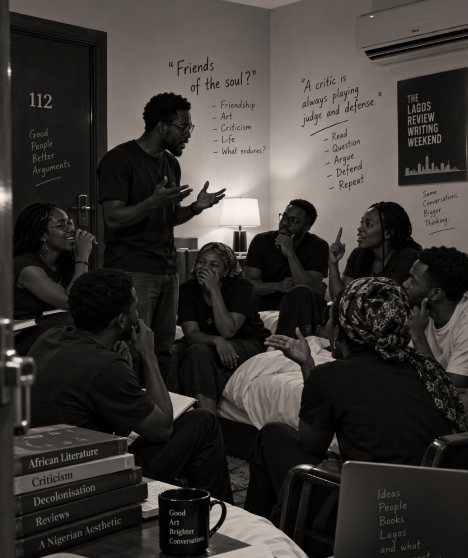
When AO casually mentioned he has friends of the soul — a vague but strangely familiar concept, two things happened. First, the plainness and strangeness of the phrase disarmed us: ST, JJ, AO, DI, AM, PA, and me, into sporadic laughter. That cacophonous laughter must have disturbed fellow hotel occupants and marked us as the cliché noise makers. But we laughed on!
Next, an endless exchange of opinions ensued. Fittingly, AO, standing across from us, his impatient and judgmental jury, made his case for minutes. Each sentence and phrase eliciting laughter and deep thinking. But what stood out, weeks after that seemingly simple exchange, is simple: the conversation summarized the job of a critic as an endless game of playing defense against a bloodthirsty and impatietnt jury.
Globally, criticism is regarded a solitary and thankless affair that invites glances. These glances have been fittingly described and adopted by the trio of Nigerian scholars: Chinweizu, Onwuchekwa Jemie, and Ihechukwu Madubuike in their seminal 1980 work, Toward the Decolonisation of African Literature. They proposed a radical and combative approach to literary criticism that rejects Eurocentric standards in favor of indigenous aesthetics and decolonization.
The job of a critic, though a smooth oscillation between a dovish approach and guerilla-induced commentary, is a lifelong engagement of playing judge and suspect.
In reviews, they take this God-like posture dictating, like every tyrannical leader, what’s good and bad. The reviews and essays are written in scorching and verdict-given languages. But, despite their God-like posturing, the critic is still suspected for holding a view. Thus, all his life, he has to defend his sentences to editors who, like him, aren’t kind when pruning his paragraphs, romantic partners and friends who don’t share and understand his madness and eclipsing obsession with art, and writers, filmmakers, artists whose works he had vigorously punched.
Summary: the life of a critic is a boring cycle of playing judge and defense. Thus, as AO defended his “friends of my soul concept”, within the chilly Room 112, it reminded me of the long tradition of critics whose words have inspired intimate and publicized arguments.
We were 15 lucky participants selected for the inaugural The Lagos Review Writing Weekend Workshop and it was day three. The sessions were incredibly dense with lessons and nuggets from the facilitators: Akumbu Uche, Oris Aigbokhaevbolo, Adewale Maja-Pearce, Eghosa Imasuen and Toni Kan. The dogmas of punctuations were preached, care and kindness in reviews were emphasized, and the tussle of building a sustainable career as a professional Nigerian critic was contested with.
That night, however, it was just 8 of us in Room 112, sharing anecdotes and arguments. But, what has stayed with me months later is the endless argument about the simple “friends of my soul” phenomenon. Thus, after A.O’s vigorous defence of his thesis and everyone slouched off to their room in small numbers, the room became less heavy with laughter and opinions, and the AC’s steady whooshing sounds monopolized the room, my mind settled on the three sessions we’d had at the workshop.
Sessions I figured were training us to be like AO: articulating and defending our opinions with fine language and alarming confidence to patient and impatient listeners.
**Seyi Samuel was a member of the 2026 cohort of the Lagos Review Writing Weekend workshops.