

There is the unspoken assumption that in witnessing something great, sacred or worthy of respect and adoration, there must be a reduction of self; whether it is the bowing of the knee, prostrating or the shedding of covering.
There is almost always reduction, a humbling of self that is necessary to happen before witnessing something sacred.
Walking into the hush of the Gallerie d’Art at Alliance Française, that feeling compels one to put down one’s device, or even dispose of certain thoughts, to unburden the mind to make space for this immersive experience of what is home.
American artist, Virgil Abloh, commenting on the importance of spatial design in relation to art display, said ‘I could either design the candle, or I could just design the room that it sits in.’
 Alliance Française did a masterful job of creating a secluded space where art can stand in its own hushed light. The space is wide enough, with competent spatial architecture to sustain the wonder that is akin to the turning of a page.
Sometimes, it takes an untrained eye to recognise the importance of art because the witnessing of art makes it clear that art is not meant for just artists and experts, but for everyone who wants to feel, to witness.
The Badagry Young Contemporaries, under the expert guidance of Paul Ayihawa and Ladunni Lambo, presented ‘With Love from Home’ as a group exhibition that managed to collectively recount what is considered home by seven distinct voices in one beautiful story. ‘With Love From Home’ is a postcard from a familiar place faraway, addressed to one person.
Its triumph lay in its ability to appeal to whatever perception of home one might have even though the Badagry Young Contemporaries generally seek to spotlight the young artistic voices of Badagry, often displaying southwestern culture for viewing. Naturally, Yoruba domestic life and experience is explored. However, in this exhibition, art from different cultures was displayed as well. The collective understanding of the portrayal of domestic life, and emblematically domestic artwork shows how art transcends cultural differences, speaking in a language that requires no translation
Personal art is specifically emblematic of personal interpretations of themes. This is evidenced in each of the seven artists’ techniques and their artwork, working hand-in-hand to portray a familiar place to an unfamiliar audience.
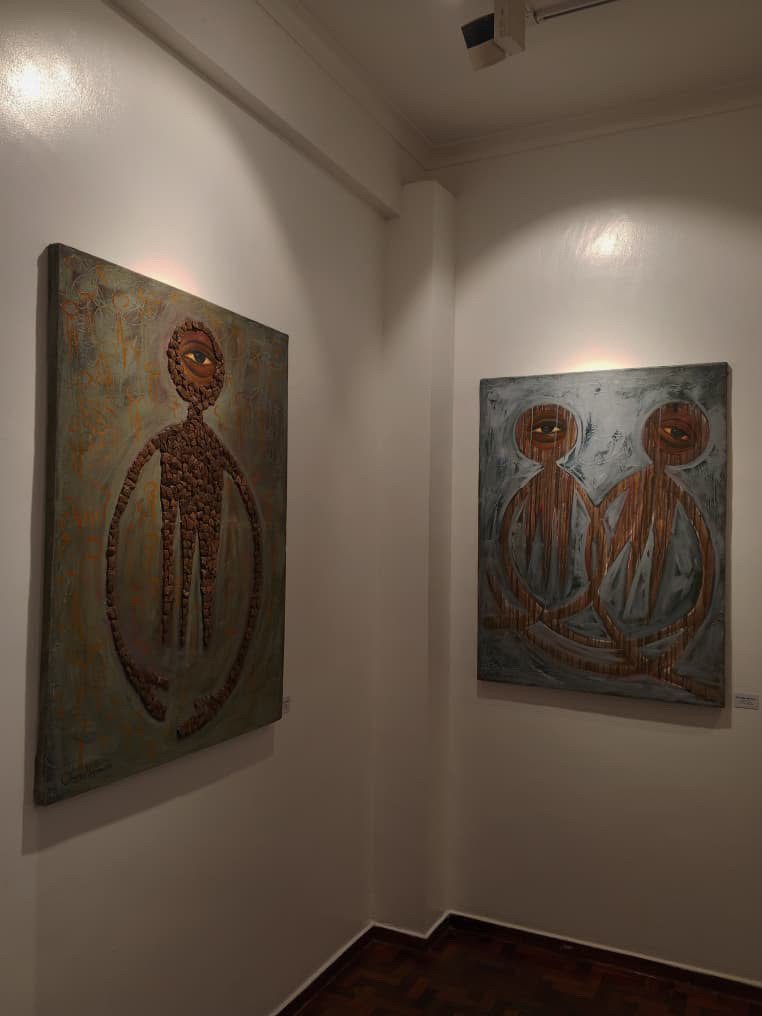 Olayinka Muyideen uses a popular symbolic object, ilarin, as a motif in many of his designs, to portray bodies. Simply using coconut shells and acrylic on canvas, the artwork creates its own aura, with eyes sager than the caricature of the rest of the bodies, leaving a staying impression on the beholder.
Andrew Oshobodo grounds his art in Edo culture. He appropriates art nascent to his cultural origins, from a reimagined lens. In his Oviedo series, there subsists certain surrealist elements in the art he appropriates of ancient cultural artifacts, demonstrating the point where reality meets imagination and memory.
Mariam Olubunmi simulates home using pyro collage to create distinct portraits. Using the old pieces of burnt newspaper, gradually she engineers puzzle-like images with a clear visual. It is very expertly done.
Olanrewaju Olagoke’s art has a very contemporary twang to it. The paintings have comical names, appealing to younger audiences and communicating a message of shared understanding and community, in ‘50 Shades of Shege’. His work also portrays the challenge of striving towards greatness and achievement in ‘Journey to Pro.’
Messewaku Sejiro highlights his paintings with blue and red pigments, conveying nostalgia, longing and a whirlwind of other emotions in the gestures of the characters he paints.
Muktar Mustafa believes that home is a mosaic of everything and people you have loved. His digital art displays stills and scenes of different people, events and places–a collection less targeted in its artistic approach.
Israel Ashele communicates through sculptures of varying sizes. Through his sculptures, people come face-to-face with the images living in his mind, images in no way foreign to the audience.
The seven exhibiting artists seem to have laid their lives out on canvas and other media. The works etched into permanence –whether it is in the stains of coffee on paper, the framing of a painting, or even in the fixture of a makeshift football field–have a way of transporting and transfixing simultaneously, heightening the experience.
What is home? Where is home? Who is Home? These are the questions the artists sought to answer. The exhibition seemed intent on debunking the almost idyllic sense of what art should portray as home: sunsets on horizons, landscape views, and not the quotidian existence of the things which make up memory and life.
Home cannot be separate from imagination, which cannot be separate from memory and perception. In the absence of a textbook definition of what Home may look like, art subsists.
(Find out more about the paintings @badagryyoungcontemporaries on Instagram.)
***Keyukemi Usani is a writer, currently studying Law at Babcock University.
Catch her on X. @k3yukem1