

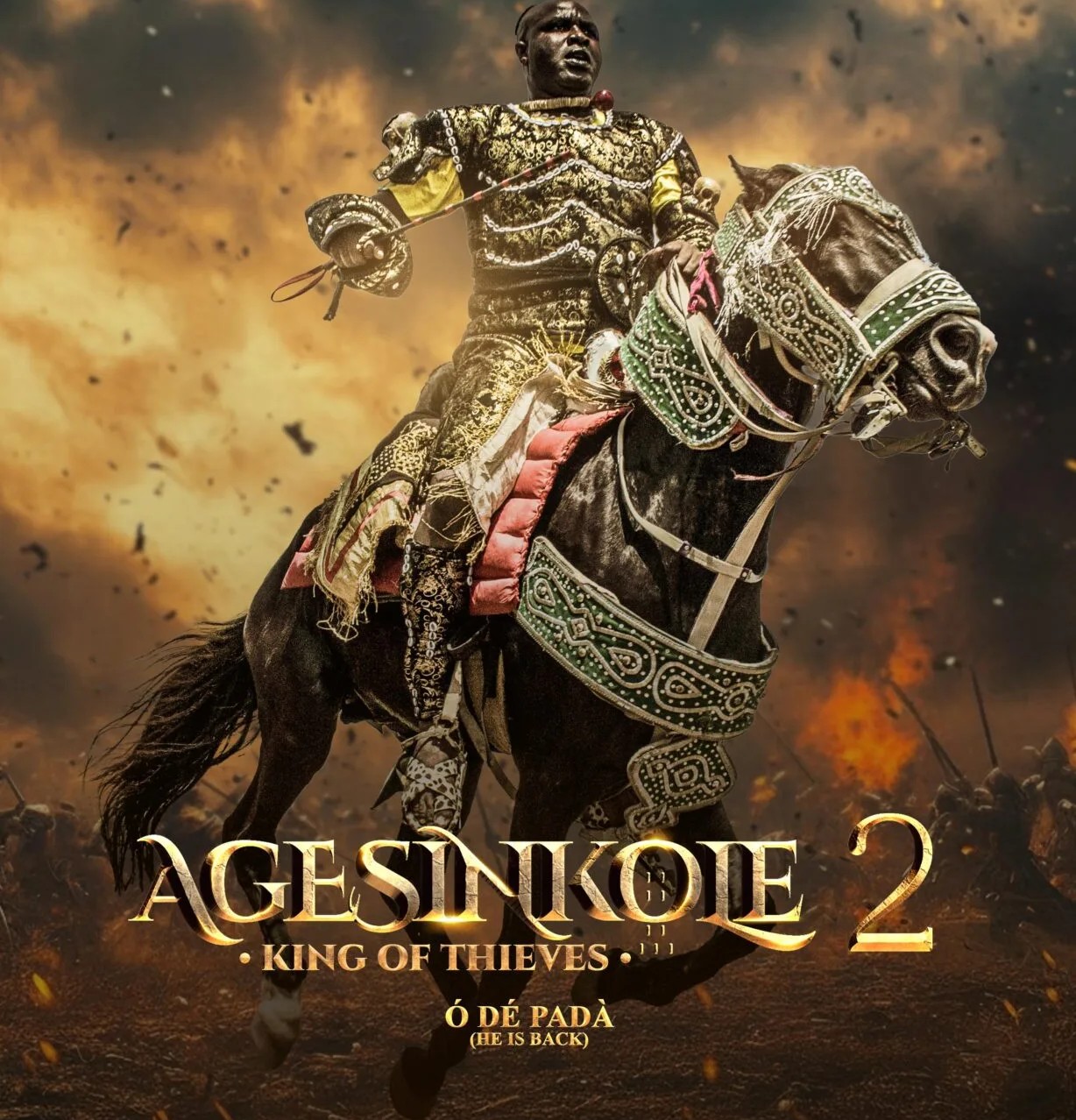
When Agesinkole: King of Thieves 2 arrived on Netflix on July 24, it was not simply another Nollywood epic entering the streaming ecosystem. It was a film carrying one of the industry’s most unusual success stories.
Months before its streaming debut, Femi Adebayo’s production bypassed Nigeria’s cinema multiplex system almost entirely, embarking instead on an ambitious community cinema tour across six South-West states and Kwara. The experiment proved remarkably successful, earning more than ₦425 million and demonstrating that audiences outside the country’s major urban exhibition centres remain commercially significant when films are taken directly to them.
For an industry increasingly dependent on multiplexes or global streaming platforms, Agesinkole 2 quietly suggested another possibility: perhaps the future of Nigerian cinema is not only about building more cinemas but about rethinking where cinema itself happens. That industrial achievement inevitably shapes how one approaches the film itself.
 While a novelty in the age of cinemas and streaming, it is not entirely new. The community theatre style was favoured by the likes of Herbert Ogunde and Ade Love in the 70s with rural dwellers entertained at night with screens attached to trucks. Their “Traveling theatre” formula was essentially upgraded “Traveling Cinema.”
Once we look past the success of this “novel” distribution, however, a more difficult question emerges. Does Agesinkole: King of Thieves 2 justify the conversation it has generated as a work of cinema? The answer is more complicated than its box office figures might suggest.
Directed by Femi Adebayo alongside Tope Adebayo and Adebayo Tijani, the sequel takes place years after the events of King of Thieves (2022). The feared outlaw Agesinkole has become far greater than folklore. In Ajeromi Kingdom, he is worshipped as a divine symbol of justice, his name invoked whenever a new monarch ascends the throne. Kings are expected to swear an oath before him, binding themselves morally to the people they govern.
King Adenitan (Yemi Solade) refuses. With the complicity of powerful chiefs, he suppresses the deity’s influence through forbidden rituals, transforming the kingdom into a machinery of corruption where public wealth becomes private property and dissent is met with violence. Unsurprisingly, justice eventually demands its own intervention.
It is a wonderfully ironic premise. The idea of an outlaw becoming the moral conscience of an entire kingdom cleverly elevates the mythology established in the first film. More importantly, it produces an allegory that scarcely needs translating for contemporary Nigerian audiences. Institutions designed to guarantee accountability are frequently captured by the very people meant to answer to them. Oaths become ceremonial. Justice becomes negotiable. State capture becomes the norm.
The screenplay, unfortunately, seldom displays the same discipline as its central idea. Instead of trusting the dramatic potential already embedded within this conflict, it repeatedly wanders into secondary narratives that complicate rather than enrich the story. New conflicts emerge only to dissipate. Characters appear carrying narrative importance that never quite materialises. The cumulative effect is less complexity than congestion.
One begins to feel that the film mistakes narrative quantity for dramatic weight. This has inevitable consequences for pacing. Historical epics demand patience from audiences, but patience works only when every scene feels like another stone laid carefully toward an inevitable climax. Here, long stretches merely delay arrival. Rather than steadily tightening around its central conflict, the film periodically loses momentum before finding it again.
Ironically, the film’s conclusion suffers from the opposite problem. After asking viewers to navigate an overextended middle section, the third act unfolds with surprising haste, resolving tensions that deserved considerably more dramatic space. The imbalance leaves the climax feeling emotionally lighter than the story has earned.
Perhaps the greatest irony surrounding Agesinkole: King of Thieves 2 is that its most significant legacy may ultimately lie outside the frame itself. Long after debates over its screenplay have faded, its community exhibition model will likely remain an important reference point in discussions about film distribution in Nigeria. It demonstrated that audiences underserved by conventional exhibition infrastructure can still sustain ambitious local productions when filmmakers rethink the routes by which cinema reaches them. However, its industrial achievement should not excuse its artistic shortcomings.
As cinema, Agesinkole: King of Thieves 2 is an uneven but often engaging historical epic whose political allegory ultimately proves stronger than its storytelling discipline. As an intervention in how Nigerian films might find their audiences, however, it may prove genuinely transformative. Sometimes a film’s most enduring contribution is not the story it tells, but the path it clears for those that follow.
**Joseph Jonathan is a Film & Culture Critic. Catch him on X @chukwu2big