

How To Be A Good Wife, Amarachukwu Obika-Stevens, 2026; Purple Shelves, pp 103
The year 1936 marked the publication of Do’s and Don’ts for Wives by , a follow up to the 1913 book, Don’ts for Wives, one of the earliest self-help books, it was marketed at middle class British women and filled with advice like “If you don’t tidy yourself up, …. don’t be surprised if your husband begins to compare you unfavourably with the typist at the office” and “While face powder may catch a man, baking powder is the stuff to hold him.”
These maxims are hardly the contents of a feminist manifesto, but the book seems to have struck a chord with its target audience because almost a century later, it remains in print under the updated title How To Be A Good Wife. That said, this British manual is not to be confused with its Nigerian namesake — the short story collection by Nigerian publisher and author Amarachukwu Obika-Stevens.
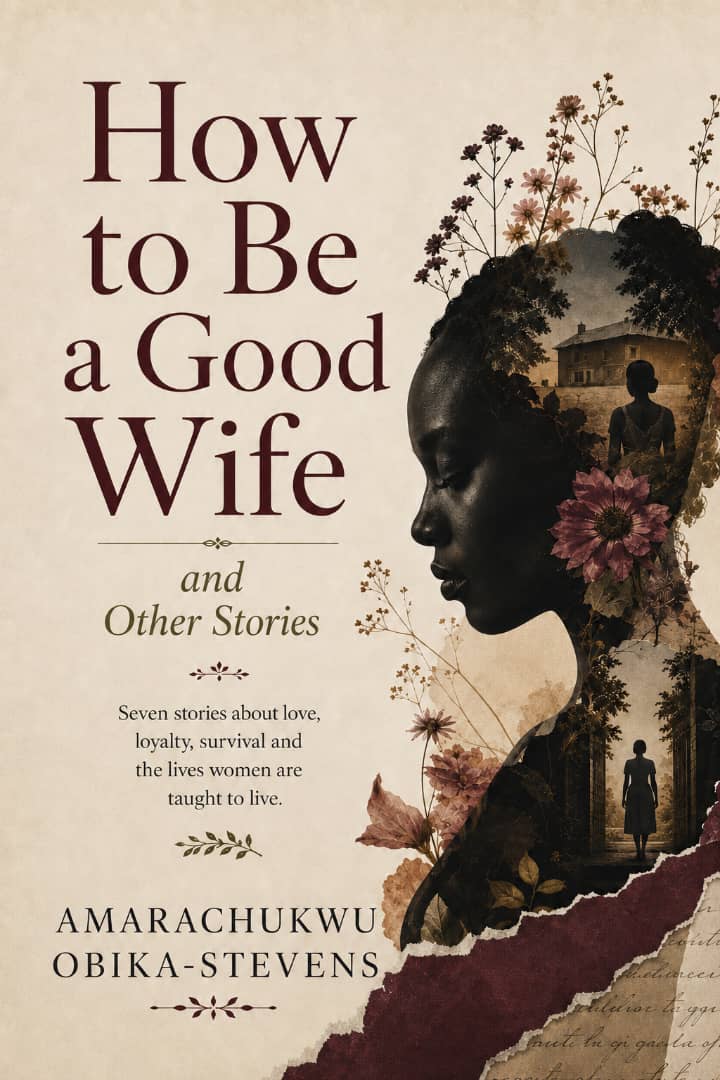 In the collection’s seven stories, Obika-Stevens focuses on marriage and romantic relationships. Far from their romanticised portrayal in popular culture, Obika-Stevens reveals them to be battlefields where women fight for their stake by any means necessary. This is illustrated in “Love +/- Reason = Madness”, where an impressionable young woman joins a witches’ coven as a prerequisite for marrying into a particular family.
Likewise, Nkolika, the protagonist of “How to Snatch a Man From His Wife: A Practical Guide to the Side Chic Codes”, pursues an affair with a man she meets at the bank where she works with the strategic disposition of a wartime general.
Sometimes the outcomes of the battles the women protagonists in How To Be A Good Wife find themselves embroiled in are literally, a matter of life and death.
Unfortunately, Nigeria is a patriarchal country where women are commonly objectified or regarded as property and as such, violence against women is prevalent. The Ministry of Women Affairs and Social Development estimates that one out three Nigerian women have experienced sexual violence, but gender-based violence can also manifest in other forms including, but not limited to physical, psychological, and financial abuse.
Obika-Stevens understands this and the social dynamics that normalize this kind of harm, which is why she takes care to populate her stories with wrongdoers who are not cartoony villains and trauma survivors who are not perfect victims. In her characterisation, both demographics are made up of everyday people looking out for their personal interests in the only way they know how.
In “Gardener”, for example, she presents us with a pastor who likens his marriage to a garden, and his wife, Ada, to a flower, and thinks of his habit of buying her gifts as “tending” and “watering.” These agricultural analogies sound romantic until he applies that logic to excusing physical assault as “weeding” and “pruning.” Yet, even as the author places the reader in the perpetrator’s point of view, she does not leave room for doubt that the character’s actions are anything short of contemptible.
While her prose is trained on exposing societal ills, Obika-Stevens also celebrates moments of amity and community bonding. An example of this is the story “Edidiong”, which portrays a woman and her housemaid overcoming their class differences to build a reciprocal friendship.
On the whole, Obika-Stevens’s fiction stands out for its realism and conversational dialogue, as well as how she manages to handle sensitive topics with a serious but gentle touch.
As a bonus, readers who like to get tactile with their books will be pleased to learn that this one contains two healing mandala patterns that can be filled in with coloured pencils or markers, and would prove to be a healthy diversion for anyone unsettled by any of the book’s heavier sections and subject matter.
***Akumbu Uche is a writer and storyteller from Nigeria. A regular contributor to thelagosreview.ng, her work in arts journalism and cultural criticism has also been published by African Business, Cultbytes, IMPULSE Magazine, The Nation, New African Magazine, Service95 and Strange Horizons. Follow her on X.