

Nigerians have become accustomed to certain things that the absurdity of them no longer surprises us.
In response to broken promises, failing institutions, unreliable public services and the quiet disappointments of governance, we complain, we curse, we pray and, often, we laugh.
Sometimes laughter is relief; sometimes it is the only language left for making sense of a country that can be both painfully familiar and endlessly unbelievable. Few things expose these contradictions quite like satire. With the Naija Spirit Campaign, renowned poet and author, leans into this paradox, crafting a theatrical experience that entertains without blunting its political edge.
On Saturday, the 25th of July, 2026, the Naija Spirit Campaign arrived in Enugu as part of its nationwide tour, taking the stage at Bon Hotel Platinum. Blending spoken word, storytelling, theatre, music and dance, the production unfolded as a layered meditation on nationhood, memory and civic responsibility, inviting audiences into an evening that was as intellectually engaging as it was artistically ambitious.
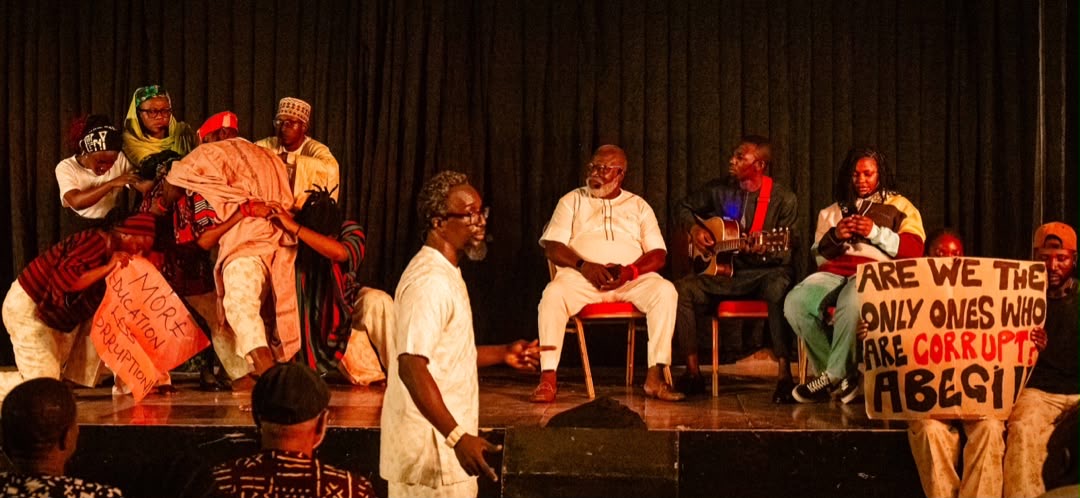 Chukwumerije took the stage, guiding the audience through a series of interconnected scenes that wove together spoken-word poetry, storytelling and music. Revisiting the story of Major Chukwuma Kaduna Nzeogwu, a military officer whose trust was shattered by betrayal during the Nigerian Civil War, the performance traced the enduring consequences of conflict, inviting the audience to reflect on how suspicion, fractured loyalties and historical wounds continue to shape contemporary notions of nationhood. As Chukwumerije’s solo performance gave way to a full ensemble presentation, drama, choreography and music expanded the questions raised in the opening narrative, shifting from history to the present through satirical scenes that interrogated corruption, prejudice, civic complacency and the contradictions of everyday Nigerian life.
It is here that the Naija Spirit Campaign reveals its true intention. The production is less interested in offering patriotic reassurance than in exposing the contradictions of Nigerian life through satire, inviting audiences to laugh before confronting the discomfort beneath that laughter.
Having established the production’s emotional and historical foundation through his solo performance, Chukwumerije remains its steady centre of gravity. His measured delivery, commanding stage presence and effortless movement between storyteller, griot and performer give the production its cohesion even as the ensemble broadens its thematic scope.
That said, the Naija Spirit Campaign is unmistakably an ensemble effort. The cast delivers performances that are disciplined, energetic and sharply attuned to the production’s satirical vision. Among them, Kayode Aiyegbusi stands out as the self-important “big man,” embodying the arrogance and contradictions of a corrupt political elite with a performance that drew some of the loudest laughter of the evening not because the character was exaggerated, but because he felt so recognisable. In a similar vein, Yausahyel Suleiman, portraying an NGO worker, serves as the production’s moral compass and voice of hope. In one of the evening’s most poignant moments, her character is confronted with a disarming question: Would she still believe in hope if believing in hope were not part of her job? The exchange distills the production’s scepticism towards easy optimism while refusing to abandon the possibility of hope and change.
The dance ensemble sustains the production’s momentum with disciplined, energetic performances that give equal weight to its emotional and political rhythms. In this production, music and choreography are not ornamental additions; they function as a language of their own, extending and reinforcing the ideas unfolding on stage.
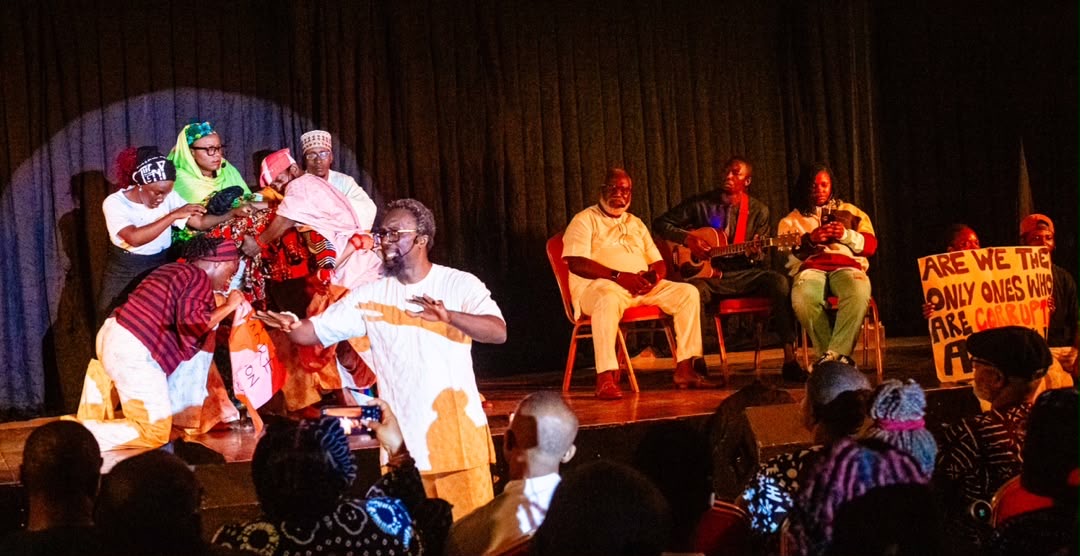 This is most evident in the use of Fela Kuti’s Zombie. As the familiar refrain filled the auditorium, the audience erupted not merely out of nostalgia, but out of recognition. The song’s indictment of blind conformity deepened the satire already unfolding on stage, giving musical expression to the behaviour embodied by the characters. Rather than interrupting the narrative, the music amplified it, allowing the audience to grasp the production’s critique with even greater clarity.
The Naija Spirit Campaign succeeds not because it offers solutions to Nigeria’s problems but because it refuses to let its audience hide from them. By turning familiar frustrations into satire, Chukwumerije reminds us that laughter can be a form of recognition but recognition is only the beginning of change.
By the end of the performance, he leaves the audience with a definition of resilience that is at once inspiring and unsettling: “If the door is shut, we will use the window. If the window is shut, we will use the roof. If the roof is shut, we tunnel through the ground. That is the Naija spirit.”
The line drew applause, but it also lingered as the house lights came up, posing the evening’s most urgent question: should Nigerians continue celebrating an extraordinary capacity to endure every obstacle, or should that same resilience be redirected towards demanding a society where tunnelling through the ground is no longer necessary?
The Naija Spirit Campaign was produced by the Simply Poetry Foundation with financial support from the Ford Foundation. High profile attendees included Emeka Mba, CEO of Afia TV, human rights scholar Prof. Joy Ezeilo, Chief Ben Etiaba and veteran actor Chief Chika Okpala popularly known by his alias, Chief Zebrudaya Okoroigwe Nwogbo.
** Charity Ezeja is a Nigerian writer, poet, and arts administrator whose work explores culture, memory, identity, and civic life. Her work has appeared in Cost of Justice, an anthology published by the South Saharan Social Development Organization.