

A particular kind of quiet settles over a gallery’s exhibition preview in its first hour of life, before the wine runs low, before the small talk hardens into opinion.
AINA held that quiet on Saturday afternoon, at the private viewing for “Introduction,” a group show bringing together the Zimbabwean-British artist Bokani, the Ugandan-British artist Birungi Kawooya, and the Lagos-born painter Jessica Soares. By 1pm the space on Raymond Njoku Street, just off Awolowo Road in Ikoyi, was already doing the thing a good opening does: turning strangers into a temporary congregation, all facing the same wall for slightly different reasons.
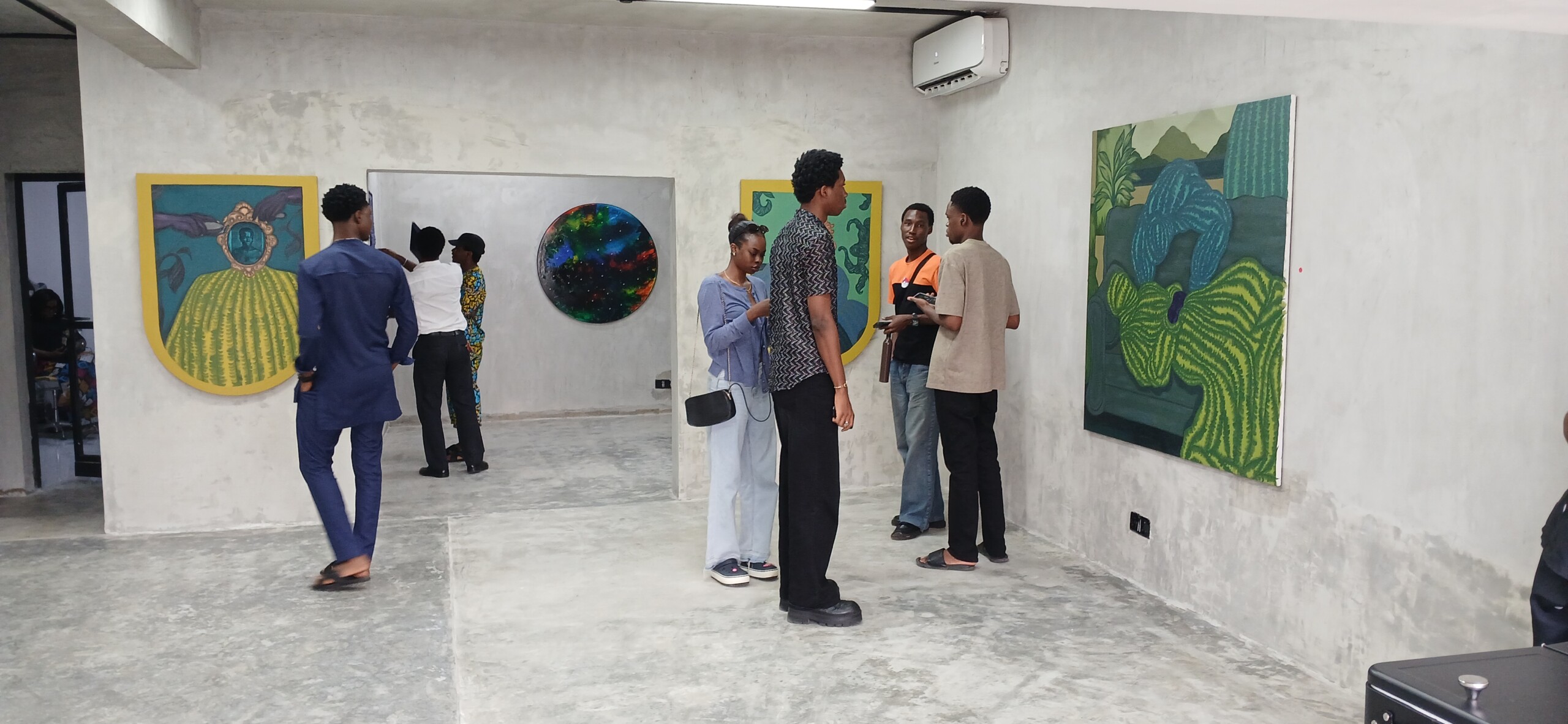
Inside the building itself is “unfinished” in the way that has become a kind of house style for Lagos’s newer galleries; bare cement walls and floors, exposed surfaces, the architecture declining to compete with the work, and in this case, succeeding. Against that grey, the paintings arrived with some force. A young man stood before two large Victorian-style crest canvases, Soares’s “But I Am Still the Same” and The Myth I Once Believed, “ while, a few feet away, a knot of visitors debated something in front of a circular painting so dense with cosmic colour it looked lit from within. Bokani’s “Cosmic Bodies” held court on its own like that, a 46-inch disc of glass enamel, mirror and aluminium, doing the thing the best abstraction does: refusing to resolve into a single reading no matter how long a viewer stood there.

Adeyinka Ayoola, AINA’s founder, held court of his own kind mid-conversation with a cluster of guests, a lawyer by training, now presiding over what is fast becoming one of Ikoyi’s more considered project spaces. He has a way of talking about the gallery’s programme that sounds less like promotion than like an argument still being built in real time, which seems the right disposition for someone trying to make a case for African contemporary art on its own terms rather than as an import category. “Introduction” is that argument made visible: an exhibition title that does double duty as mission statement, since for two of its three artists, this is quite literally a first, their debut presentation in West Africa, after careers built substantially in London and across Europe.
That fact matters more than it might first appear. Bokani and Kawooya have both exhibited widely: Bokani’s list of credits runs through the Finnish Museum of Technology, the Walker Art Gallery, and a solo show at the National Gallery of Zimbabwe, alongside commissions for the Mayor of London, Gucci’s New Bond Street programme, and an Ozwald Boateng installation at Selfridges. Kawooya’s practice, meanwhile, has been shaped less by gallery walls than by seven years of participatory “healing art playshops” developed through her Mindful African Studio, work held in the collections of Soho House and Charing Cross Hospital. Both women, in other words, arrive in Lagos with international careers already fully formed. What AINA is proposing is that the show still matters as a beginning, not because the artists need discovering, but because their presence in West Africa reroutes a conversation that has, for too long, run mostly through European and American nodes before doubling back to the continent, if it comes back at all.
Bokani’s contribution to the show reads as a study in restraint interrupted by colour. “Ukholo (Belief in Ndebele),” is built from icansi (woven reed mats) layered under oil, acrylic and spray paint, the whole surface worked into deep blues that read almost monochrome from across the room and then splinter, up close, into visible weave and texture. It is a piece that rewards patience in a way a private viewing rarely allows for, which perhaps is its own quiet critique of how contemporary art gets consumed at openings. Beside it, “Flowering Eden,” an acrylic tangle of greens, yellows and rust, feels looser, almost botanical in its chaos, evidence of an artist moving fluidly between the meditative and the exuberant, technology and hand, computation and craft, without treating any of those as contradictions.
Kawooya’s cut-paper silhouettes were perhaps the surprise of the show. Her “Hiplet Ballerina,” four dancers rendered in card and batik, their bodies filled with a mottled bronze pattern against negative black space, have the graphic punch of a woodcut and the tenderness of a family photograph simultaneously. The three-part “Josephine Baker” series pushes this further, setting the same silhouetted figure against banana-leaf backgrounds in shifting palettes of jungle green and teal. There is something quietly radical in choosing Baker as a recurring figure here, a woman whose image was so often taken from her and reframed by others’ desires, now handed back her own outline, her own leaves, her own colour story, her own self. Kawooya’s practice, rooted in olubugo bark cloth and banana fibre traditions, treats material itself as inheritance; watching her paper figures mid-leap, it becomes clear why she calls her methodology a form of collective care rather than simply an artistic technique.
Soares was in the room herself on Saturday, moving between clusters of guests with the slightly distracted warmth of someone whose work is doing more talking than she currently wants to. Her three canvases in the show, “While I Lay Here and Wait,” “The Myth I Once Believed,” and “But I Am Still the Same, ” form an unofficial triptych about looking and being looked at. The latter two share a device: an oval portrait, framed like an antique locket, set atop a body rendered entirely in the ribbed texture of adire cloth, the face inside the frame often obscured, submerged, or held at a remove by a pair of disembodied hands. It is a striking visual argument about the gap between how a body is presented and who is actually inside it, informed, the catalogue notes, by Soares’s own experience of hair loss, though the work never asks to be read only autobiographically. “While I Lay Here and Wait,” the largest of the three at 56 by 54 inches, drops the portrait framing altogether in favour of two abstracted, textile-patterned forms draped across a sofa, and is, if anything, the most unsettling piece in the room precisely because it withholds the face.
What “Introduction” ultimately argues, and arguably does well, is that these three practices don’t need to agree with one another to belong in the same room. Bokani’s cosmology, Kawooya’s collective ritual, and Soares’s interrogations of visibility are not variations on a theme so much as three separate conversations that happen to share a language of material: cloth, pattern, the body as surface and site. AINA’s bet is that West Africa is ready to host that plurality rather than flatten it into a single “African art” narrative for export. On the evidence of a packed opening on a Saturday afternoon in Ikoyi, that bet looks, for now, like a good one.
“Introduction” runs at AINA, 44 Raymond Njoku Street, off Awolowo Road, Ikoyi, from 1 to 29 August, daily from 4pm.