

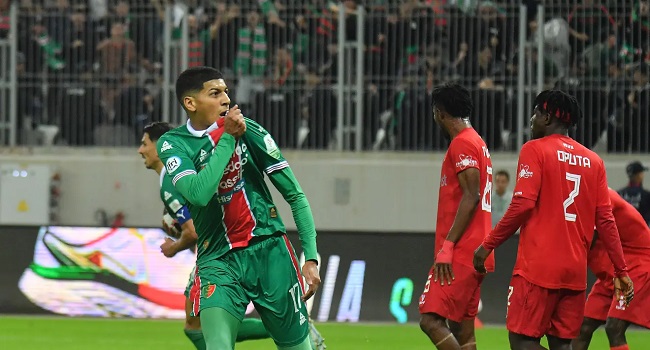
Two goals in the final ten minutes gave Rangers International a 2-0 lead over MC Alger on 18 October 2026. Nigeria’s Flying Antelopes won the first leg of their CAF Champions League second preliminary-round tie in Abeokuta despite playing much of the match with ten men. An 83rd-minute penalty and an 87th-minute goal by James Emo turned a difficult afternoon into an advantage Rangers will carry to Algeria for the return on 23 October.
For a club inseparable from Enugu’s football identity, the result also sharpens an old question: what travels when a team plays away from the city associated with its history? The home leg took place at the MKO Abiola Sports Complex in Abeokuta. Enugu remained central to the narrative, even when the match-day crowd and physical surroundings were somewhere else.
The red card made the victory a different kind of story
Rangers did not construct their lead from 90 minutes of numerical superiority or sustained attacking dominance. CAF’s first-leg report confirms they spent much of the contest with ten players, before breaking through late. That distinction matters because dramatic scorelines tend to erase the conditions in which they were achieved. An opponent chasing a tie can gain control of territory without necessarily creating high-quality chances; an understrength team may preserve its defensive shape and still find a decisive counterattack or set-piece opening.
The penalty arrived in the 83rd minute. Emo followed four minutes later. Two rapid scoring events changed the aggregate position, but they did not settle the tie. MC Alger now has to decide how aggressively to pursue goals at home without creating the space Rangers could exploit. The first leg supplied a lead, not a right to qualify.
 Enugu is a character in the fixture, even from another city
 Enugu is a character in the fixture, even from another city
The club’s name carries a regional identity far beyond the 11 players on the pitch. Rangers International has long been associated with Enugu and southeastern Nigerian football memory; supporters interpret an African campaign as a continuation of that collective story. Hosting the first leg in Abeokuta introduced a geographic split between club identity and match venue. It does not make the victory any less significant, but it complicates easy references to a home crowd as the decisive ingredient.
Supporters carry club history into radio call-in shows, replica shirts and conversations about earlier continental campaigns. An away journey to Algiers brings those attachments into contact with a different supporter tradition and a different public language. The rivalry has sporting stakes, not an invented cultural hostility. Writing about the match responsibly means describing the actual people and institutions, rather than assigning symbolic differences to entire countries.
Three scenes that will define the return
- The first 15 minutes: whether MC Alger commits extra players forward immediately or tries to force Rangers into a slower defensive retreat.
- The first goal, if it comes: whether it changes the aggregate calculation or creates space for the Nigerian side to counter.
- The final quarter-hour: the point when substitutions, fatigue and time pressure can alter the shape of a two-leg contest.
A lead and a price do not tell the same story
Supporters often treat a 2-0 first-leg score as evidence that the return should be straightforward. A market on the 90-minute result asks something different from a market on qualification: MC Alger could win the return by one goal and still be eliminated on aggregate. Supporters looking at Melbet Kenya official listings should first verify the operator’s web address and the settlement terms for each market. The term ‘qualify’ cannot be substituted for ‘win the match’ when analysing the same fixture. Any published price is a conditional assessment, not a certification of what will happen in Algiers.
An implied probability can help separate confidence from instinct. Decimal odds of 2.50 correspond to an unadjusted 40% probability, although a bookmaker’s margin prevents a direct comparison with a fair model. More useful than arguing about who is ‘destined’ to progress is comparing the likely game states: an early Algerian goal, a goalless first half, or a Rangers counterattack that forces the host to score even more.
The second screen has changed the rhythm of fandom
Continental football is rarely followed on one channel alone. Supporters alternate between radio commentary, match clips, group messages and constantly refreshed statistics. Those feeds can disagree for several minutes after a contentious decision, especially when highlights arrive later than the live event. Anyone searching for login Melbet Kenya during the return leg should independently verify the destination rather than trust a social-media link or an unfamiliar search result. Match discussion, account access and settlement status belong to different information systems. Conflating them is how a small delay can become a larger misunderstanding.
The companion screen also changes how the match is remembered. A dramatic penalty appears as a short replay; a ten-man defensive recovery requires a longer passage of footage. Football storytelling loses something when every sequence is compressed into the same 15-second clip. For Rangers, the decisive questions will include how long their shape holds, not merely whether the next highlight contains a shot.
Algiers gets the last word on the field
CAF’s schedule sets the return for 23 October. Rangers go into it two goals ahead, while MC Alger will be playing at home after failing to score in Abeokuta. The Nigerian club’s 2-0 result is now a tactical resource: it can change when to press, how much risk to accept with possession and which transitions to protect. Supporters attach meaning to those choices. Their effectiveness will be decided on the pitch.
The most revealing moment may be quieter than either of the first-leg goals: a Rangers midfielder choosing to retain the ball under pressure, or an Algerian defender stepping into a passing lane before a counter can begin. Such moments decide whether the familiar Enugu story continues into the group stage or ends at the second preliminary round.