

Curiosity made me join Lagos Life – with a little healthy dose of peer pressure thrown in for good measure.
Everyone seemed to be talking about it, and as someone who enjoys exploring worlds, real or imagined, I wanted to see what the fuss was about. Besides, how bad could a virtual Lagos possibly be? I live in the real one. I figured I was qualified for the experience. What I didn’t anticipate was how much a virtual Lagos would reveal about the real one.
In Lagos Life, the money you spend is fictional, but the attitude towards it can feel anything but. Created by Nigerian software developer Shalom Rayhamen, Lagos Life is a browser-based life simulation launched on 1 October 2026. Its early popularity has been remarkable, reportedly attracting seven million players within ten days and securing $500,000 in angel funding at a $10 million valuation.
Forgive my manners for not introducing myself properly. I am currently a growing billionaire, a bank manager, an investor and the owner of multiple businesses, several plots of lands, three houses and several cars across Lagos, Port Harcourt and Abuja. I have assets and the kind of financial freedom that makes you wonder why your real-life account balance hasn’t received the memo.
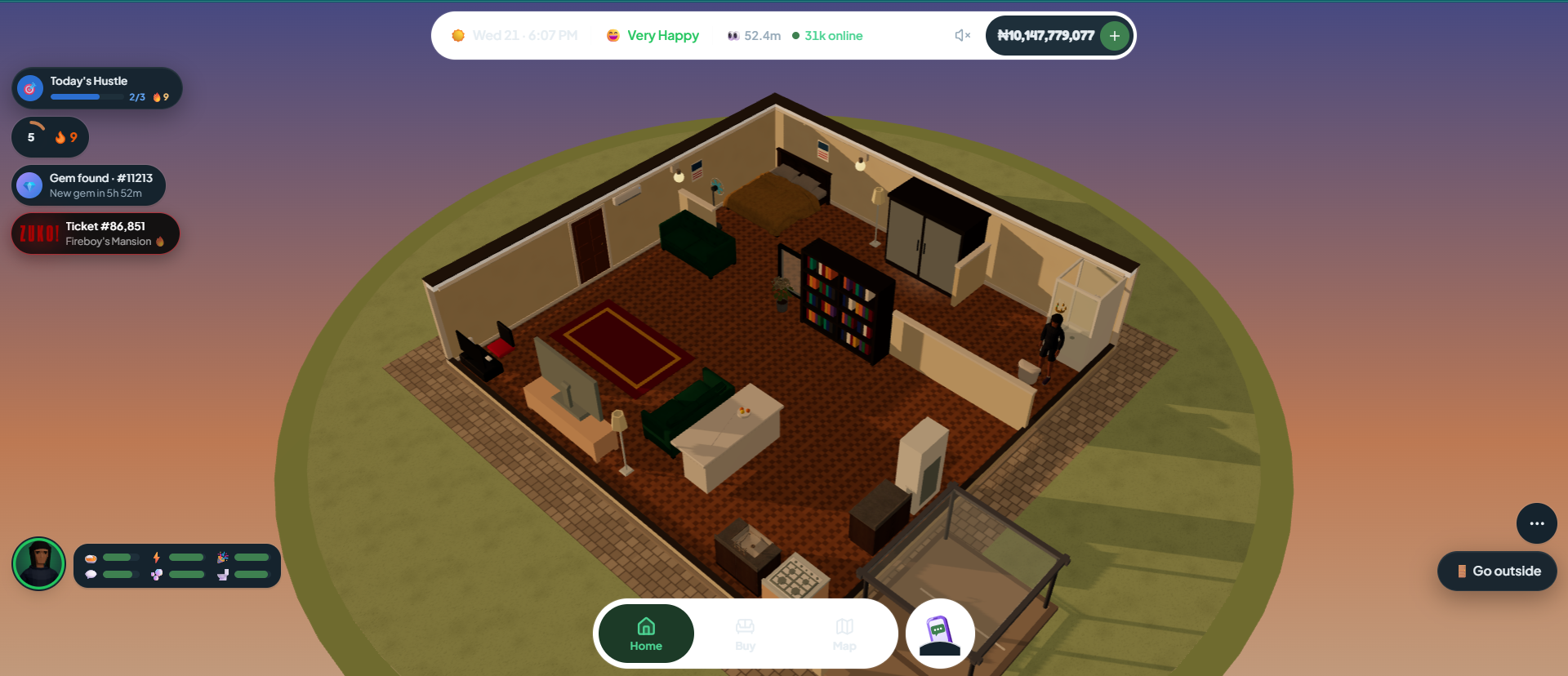 I must commend the developer Shalom who clearly took the saying “the devil is in the details” to heart. From Quilox, Freedom Park and iFitness to Owambes, Third Mainland Bridge traffic and the occasional robbery by area boys, Lagos is not just a backdrop but a fully immersive world that is part of the joke, charm and appeal of the game. Abuja and Port Harcourt are represented too, giving Nigerians a digital playground that feels like home.
For those of us like me who were assigned the financially advantageous starting point of a nepo baby, the possibilities are delightful. One minute, you’re figuring out the mechanics; the next, you’re accumulating assets like a Dangote from Temu.
Jokes aside, the game offers a low-stakes introduction to earning, spending, investing and managing assets. It isn’t a substitute for financial literacy, but it lets players experiment with money and practise the kind of life they envision for themselves. For some, it’s a virtual rehearsal for a future they intend to make real. For others, it’s simply entertainment.
 The trouble begins when you start interacting with people. A few days after signing up, I encountered a player at Quilox who randomly sent me my first ₦100 million. I had barely settled into my new existence, and somebody was already making financial overtures. Then another player entered my DMs asking for financial assistance. I sent him ₦5 million. Apparently, this was an unforgivable insult. They responded by sending me ₦50 million, presumably to establish that they were considerably wealthier than I was and had no business asking me for money in the first place.
I’ve encountered players who solicited money, assessed my character differently after seeing my CV, billed me and even offered to be my bae. Suddenly, I wasn’t just another player; I was a potential source of money, access or romantic opportunity. The CV, it seems, is not merely a record of achievement. It is a prospectus.
In Lagos, where connections open doors and financial security is precarious, people are accustomed to assessing what others bring to the table. We may be playing a game, but we are not necessarily playing by different social rules.
Then there’s the question of men and money. In my experience, both in Lagos Life and in Lagos itself, money is deeply entangled with masculinity. Men are expected to provide, demonstrate independence and establish their worth through what they can afford, yet some become remarkably accommodating around wealthier men while using their own financial advantage to impress women or belittle less privileged men. Money becomes both a currency of male validation and a tool of control.
What interests me is this contradiction: men can be reluctant to extend financial solidarity to their fellow men yet quick to defer to a man with money. It raises an uncomfortable question about a culture that encourages men to compete for financial dominance rather than see one another’s struggles as grounds for solidarity. Lagos Life hasn’t proved that all men behave this way, but it has given me another space in which to observe how quickly wealth can rearrange the dynamics between them.
While the game’s currency is fictional, its business is real. Its developer has attracted investment, is selling advertising and building commercial partnerships around the attention players generate. While we pursue imaginary fortunes, the platform creates actual economic value. There’s nothing wrong with that; developers deserve to earn from their work. But the game offers us a space to practise building wealth while exposing how difficult it can be to separate success from the social competition and power plays we’ve learnt to associate with it.
Perhaps we’re not simply trying to escape Lagos. Perhaps we’re trying to experience a version of Lagos in which we finally have the resources to win.
When all is said and done, I like Lagos Life. I enjoy its local details, social interactions and the freedom to build a life that would require considerably more than a browser and an optimistic attitude.
I’ll keep playing, even if my greatest grievance remains that the money isn’t real. Until then, I will remain a growing billionaire with a flourishing business empire. While I may not yet be on the Forbes list in the game, I can tell you that if you believe billionaires like me have a lot to offer, then you certainly want to check out that list and perhaps reach out to the Jagabans of Lagos Life. They may surprise you.
Now, if you’ll excuse me, I’ve got a game to get back to and money to make.