

To survive in modern Nigeria is to become part of a crowd.
A single person must learn to be three at once, fracturing their identity to meet the relentless demands of an unpredictable economy. It is a distorted, earthly echo of the Trinity, the theological mystery of three persons in one Godhead, but stripped of its divine harmony. Where the Trinity exists in perfect unity, this economic trinity is forged in fracture and exhaustion; three jobs, three personas, one weary body struggling to hold itself together.
This psychological endurance test masquerading as a daily routine is the pulsing center of Chukwudi Nwachukwu’s newest series, No Rest for Us: The Grindster.
To look through these images is to confront a reality increasingly central to contemporary African life; the quiet, exhausting labour of holding oneself together while everything threatens to pull you apart. In a country where a single job rarely covers a single life, where young graduates stitch together unrelated jobs just to survive, and where self-improvement has become synonymous with basic survival, Nwachukwu’s photography does more than capture a subject. It stands as an act of witness.
Raised in the relentlessly commercial city of Aba, Abia State, Nwachukwu originally studied Mass Communication at Abia State University, Uturu, before fully committing to the lens. It is his lifelong proximity to Aba’s bustling markets and the wider commercial heartbeat of southeastern Nigeria that has uniquely sharpened his visual vocabulary.
What Nwachukwu brings to his photography is less a style than a discipline of attention, formed early and close to home. His father was a clergyman, and their household functioned as an informal counselling room, with people arriving daily, seeking guidance, help, or comfort, bearing weight the young Nwachukwu could not yet name.
It took years, he has said, to understand what he had actually been watching, “how much people carry within their lives.” This is not the sentimental humanism that so often flattens many documentary photography of Africa into a single register of hardship. Rather, it is a working method, an insistence on waiting rather than directing, on photographing, in his own words, “with restraint, allowing moments to reveal themselves.” For Nwachukwu, as he has put it himself, “a photograph is more than a visual record.”
That discipline runs through the three bodies of work that preceded No Rest for Us: The Grindster. In Soft Bodies, Hard World, he shapes a restrained study of the pressures placed on women within Nigerian ideas of femininity. In The Hills That Raised Us, he turns toward childhood and the early, often unacknowledged encounters with labour that shape so many African upbringings. And in The Labour of Rivers, he settles into the unhurried rhythms of a fisherman’s working day. Across all three, Nwachukwu’s camera has functioned less as a director than as a patient witness.
No Rest for Us: The Grindster marks a departure in form, though not in attention. The series takes as its subject the reality that, in its own words, “a single occupation is increasingly no longer enough” across much of urban Nigeria, and that people are stitching together a living out of two or three unrelated forms of work. This is not an abstract observation. It reflects the specific texture of Nigerian life in this decade with a currency that has lost more than half its value against the dollar since 2023, inflation that has hovered stubbornly above official comfort for years, and an informal economy of trading, transport, and contract work that functions, for most people, not as a fallback but as the actual architecture of getting by. For a generation raised on the promise that a degree leads to stability, and now watching friends and siblings emigrate abroad in what has come to be known as japa, productivity has become inseparable from identity.
This shift toward staged, symbolic portraiture finds a precedent in Nigerian culture, even if not directly in photography. The Onitsha market pamphlets of the mid-twentieth century, cheap booklets produced not far from Nwachukwu’s own Aba, offered readers instructions on how to speak eloquently, dress impressively, and make something of themselves against long odds. They understood, decades before Nwachukwu’s camera did, that in a precarious economy, self-improvement and self-presentation are the same project.
Seen against that background, the turn from the quiet observation of his earlier series toward performance and symbol reads less like a stylistic departure than a formal response fitted to its subject. If the hustle is itself a kind of performance, sustained daily for an audience of employers, customers, and followers, then, photographing it with restraint alone would tell only half the story.
Consider the images built around a green minibus, parked at what reads as a motor park. A man leans against the vehicle’s door in an immaculate white suit and matching fedora, a leather briefcase held loosely in one hand, the sky behind him pushed into a burning, almost theatrical orange. Look closely and the details begin to accumulate; on the bus’s side bumper, a manufacturer’s specification plate is still legible in Japanese characters, evidence that this vehicle, like the man posed against it, is living a second, repurposed life.
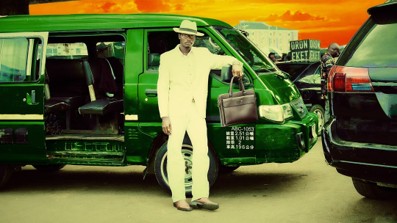
Figure 1
The companion image (figure 2) pulls in tight, cigarette held between ringed fingers, eyes lowered, the hat’s brim cutting the light across half his face. Here the performance briefly exhales. It is a quiet image in the series, and arguably the most honest one. The white suit, which reads as pure confidence from a distance, begins up close to resemble something closer to armour.

Figure 2
A second pairing trades spectacle for texture. In one frame (figure 3), a figure in a soft salmon blazer, the kind of jacket suited to an office rather than a market, grinds tomatoes through an old hand-cranked grinder, the pulp spilling red into a blue plastic basin while a wide tray of whole tomatoes glows behind him in the low light. It is a precise, economical image of the collision at the heart of the series, a jacket meant for a desk pressed into service for work fit for a labourer’s apron.

Figure 3
Its companion frame (figure 4) stands as the emotional centre of the series. The same blazer, seated in a red plastic chair, boxed in by crates and baskets, one fist pressed to the mouth, eyes fixed on something beyond the frame. In the foreground, a second figure rushes past, a body in motion against a body completely still. The stillness is what holds you. It is not rest. It is the pause of a man running calculations that do not add up, or perhaps just the pause of someone who has been performing all day and has, for one unguarded moment, forgotten that anyone is watching. Stillness and speed share a single frame. Of all the images in the series, this is the one that feels least like a photograph and most like a held breath.
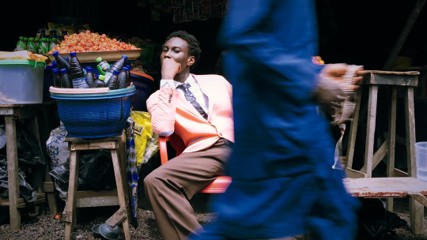 Figure 4
What holds all four images together, and what ties The Grindster back to everything Nwachukwu has made before, is his refusal to resolve the tension he’s photographing into a verdict. These are not images asking you to pity the hustle, and they do not ask you to admire it uncritically either; they insist you notice it, the way you might notice, for the first time, effort you had walked past a hundred times without seeing. “A photograph,” Nwachukwu has said, “is more than a visual record.”
Nwachukwu’s exhibition history offers tangible evidence of how quickly that attention is being rewarded. From group exhibitions all held this year such as Rebirth and Sacred Spaces: Temples of the Soul in London, to Material Work: Toil and Grace at the Griffin Museum of Photography in the United States, to On the Road with Versus Arts, his trajectory has been one of steady, rapid ascent.
His solo exhibition, at Delaroke Art Gallery in Port Harcourt, alongside coverage in Thisday, Premium Times, and People of Print, suggests an artist whose local and international audiences are arriving at the same time.
What stays with you after looking at these photographs is not the staging or the symbolism but something simpler and harder to shake, the feeling that you have seen these men before: on the bus beside you, behind a store counter, in your own mirror on a Monday morning when the week already feels too long and the month’s money is already too short.
Nwachukwu is not photographing strangers. He is photographing a condition, one that millions of Nigerians live inside every day without anyone stopping to call it what it is. Not resilience; that word has been used too cheaply and too often. Not suffering either. Something in between, something that looks like a man in a good blazer grinding tomatoes in the heat because that is what today requires, and tomorrow will require something else entirely.
The genius of this work is that it never tells you how to feel about any of it; it just makes it impossible to look away, because you are involved subtly and symbolically in the embodied story and meaning.